
COMMUNITY ACTIVIST, INVENTOR, ENTREPRENEUR, |


 |  |
| Thomas Wyatt Turner 1877-1978 | W. Ashbie Hawkins 1862-1942 |
Seeing that the PSC was of little help, the Black community sent their grievances directly to the Maryland General Assembly through the Maryland Interracial Commission, which was formed by the Maryland General Assembly in 1927. Activist groups also emerged, such as the Citizen’s Jim Crow Repeal Committee and the Independent Voters Political Welfare Club of Maryland, to voice their resentment of the Jim Crow car law and worked to convince elected officials that the law needed to be repealed.
In 1933 the Citizen’s Jim Crow Repeal Committee reached out to Senator David J. Ward from Salisbury asking him to support the upcoming repeal measure. However, Ward refused, saying that it was “absolutely against my wishes” and that Eastern Shore Citizens, both Black and White, did not want the 1904 law repealed and that both races were content with Jim Crow. Despite admitting to be acting according to his own personal wishes, Ward asserted that the Eastern Shore did not want a repeal of the law and that everyone was happy with the status quo. Senator Dudley G. Roe of Sudlersville also refused to vote for a repeal of the law, but was willing to reconsider if provided with evidence of unequal accommodations, which the community had been providing for years. Black leaders were quick to denounce Ward’s claim and called upon the community to write letters supporting the repeal of the law.
James Franklin Stewart, a prominent figure from Salisbury’s Georgetown Community and part of the Maryland Interracial Commission, made a statement which was published in the Baltimore Afro-American a week after Ward’s statement. In his statement Stewart refuted Ward’s claim that the Eastern Shore did not want a repeal of the Jim Crow car law. Stewart found it insulting that Ward made such a statement without first consulting with the very people the law had the most effect on. He also took offense that anyone believed that African Americans were willingly subjecting themselves to such a law. Claiming to speak on behalf of the Black residents of the Eastern Shore, he notes that “As an Eastern Shoreman and native of Wicomico County, I can never give sanction or encouragement to a law” which humiliates an entire group of people. Stewart concluded his statement by labeling the Jim Crow law a “curse to our racial group” and suggests Ward reconsider his stance on the repeal.
Stewart was not the only Black Eastern Shore leader to speak out against Ward. Thomas H. Kiah, the principal of Princess Anne Academy (today the University of Maryland Eastern Shore), also expressed Black resentment of the 1904 law and lamented Ward’s response. With these statements, Stewart and Kiah made it very clear that the Eastern Shore was not content with the degrading laws that made Maryland’s Black citizens feel like second-class citizens.
 |  |
| Photos of James & Mary Stewart Chipman Cultural Center | Dr. Thomas H. Kiah (1873-1936) University of Maryland Eastern Shore |
Moving forward over a decade to 1945, the now 41-year-old law was still being debated in the Maryland General Assembly and Black civil rights groups were still hard at work challenging it. In a newspaper from March of 1945, it was noted that Maryland’s senate voted 20 to 9 in favor of a repeal and that even the governor at the time, Herbert R. O'Conor, endorsed the repeal bill. In an effort to get the bill to pass the House of Delegates, 17 speeches were made before the Judiciary Committee of the House of Delegates in which representatives, both White and Black, from various organizations as well as individuals urged for the repeal of the Jim Crow transportation law. A few of these speakers hailed from our Eastern Shore, including Elwood Jewett, son of Frederick Jewett, and Salisbury’s James Stewart, who was still fighting for equal rights on behalf of his community. All of these speeches emphasized the need to repeal the Jim Crow law in order to make Maryland more democratic, ease racial tensions, and end the humiliation that many felt from the law.
One speaker, Mrs. H. Milton Wagner, claimed to speak on behalf of the mothers who have children fighting in the ongoing global war and that her son “has carried and buried men of every race in the battles... I can’t believe that he or others like him want to see more seeds of hatred in Maryland than they have given their lives for”. Wagner’s powerful declaration uses World War II, which was ongoing at the time, to support the argument for repeal. Her son was actively fighting against a regime based upon racial and ethnic discrimination. Wagner’s son burying men of every race demonstrates that skin color does not matter in death and it also highlights the hypocrisy of the United States fighting against hatred abroad while hatred and discrimination festers at home. Unfortunately, the repeal bill was defeated again, but this did not deter efforts to challenge the law through other means.
One speaker, Mrs. H. Milton Wagner, claimed to speak on behalf of the mothers who have children fighting in the ongoing global war and that her son “has carried and buried men of every race in the battles... I can’t believe that he or others like him want to see more seeds of hatred in Maryland than they have given their lives for”. Wagner’s powerful declaration uses World War II, which was ongoing at the time, to support the argument for repeal. Her son was actively fighting against a regime based upon racial and ethnic discrimination. Wagner’s son burying men of every race demonstrates that skin color does not matter in death and it also highlights the hypocrisy of the United States fighting against hatred abroad while hatred and discrimination festers at home. Unfortunately, the repeal bill was defeated again, but this did not deter efforts to challenge the law through other means.

Salisbury, MD., Union Station - 2016-096-2339
Walter Thurston Photograph Collection (2016.096)
Edward H. Nabb Research Center for Delmarva History and Culture
Walter Thurston Photograph Collection (2016.096)
Edward H. Nabb Research Center for Delmarva History and Culture
While groups were pressuring politicians and the General Assembly into repealing the act, other efforts were underway. African Americans were using the press to appeal to people’s emotions. Many of the representatives sent to the Maryland General Assembly made references to the humiliation and treatment that the Jim Crow law subjected them to, but other news articles went into far greater detail and crafted hypothetical stories based on reality that put the reader in the shoes of Black passengers. One such story, titled “Maryland Where Jim Crow Begins” places the reader in the shoes of person of color traveling from New York to Cape Charles, Virginia. On most of this trip, the traveler enjoys an uninterrupted journey where Black and White passengers casually interacted without much hostility between them. However, once the traveler approaches Delmar, the White passengers begin to feel uneasy, casting glares at the Black riders who they were cordial with just moments before. At this point, passengers were ordered to move seats. If there were fewer White passengers, they were moved to a separate car and if there were fewer Black riders, then they were moved to a separate car. The same hypothetical traveler notices the opposite when returning north. The further away from the Mason-Dixon line they go, the more the color line blurs and the train desegregates itself.
This story, based on the experiences of Black travelers, was meant to elicit an emotion response from White readers. It allowed White readers to experience what Black travelers in and through Maryland experienced on a daily basis, drawing out sympathy and support for a repeal of the law. This story also demonstrates the dehumanizing effect of Jim Crow, illustrating how a political boundary and a law could have a physical, social, and emotional effects on the citizens of Maryland. The crossing of an imaginary line on a map almost immediately dehumanized these passengers and left them as social outcasts. Finally, the scenario also shows how the law effects White passengers as they too can be moved at the will of the conductor in order to enforce segregation.
This story, based on the experiences of Black travelers, was meant to elicit an emotion response from White readers. It allowed White readers to experience what Black travelers in and through Maryland experienced on a daily basis, drawing out sympathy and support for a repeal of the law. This story also demonstrates the dehumanizing effect of Jim Crow, illustrating how a political boundary and a law could have a physical, social, and emotional effects on the citizens of Maryland. The crossing of an imaginary line on a map almost immediately dehumanized these passengers and left them as social outcasts. Finally, the scenario also shows how the law effects White passengers as they too can be moved at the will of the conductor in order to enforce segregation.

Ocean City, MD., Train Crossing Bridge - 2016-096-1196
Walter Thurston Photograph Collection (2016.096)
Edward H. Nabb Research Center for Delmarva History and Culture
Walter Thurston Photograph Collection (2016.096)
Edward H. Nabb Research Center for Delmarva History and Culture
Apart from articles meant to draw sympathy from readers, there were also legal battles against the 1904 law. In 1934, Mrs. Isabella Smith of Philadelphia was riding on a Greyhound bus returning from Princess Anne when the bus made a stop in Salisbury. Smith, who had been seated toward the center, was ordered by the driver to move to the back to give a White passenger her seat. Smith refused and the situation escalated as the driver threatened her, saying “we lynch colored people down here when they don’t obey orders given by whites,” seemingly referencing the lynching of Matthew Williams less than three years ago. Smith, was not intimidated and did not yield to the demands. As a result, she was arrested, jailed overnight by police, and brought before a judge the following morning. However, the judge ordered for Smith’s release since the law was, at least on paper, not supposed to apply to interstate passengers, and only applied to trains and steamboats, not buses. Mrs. Smith’s bravery and refusal to sacrifice her rights as an American citizen resulted in a legal victory here on the Eastern Shore.
A similar situation occurred in 1946 when another resident of Philadelphia, Levin Holland, was forcibly segregated by police on a bus ride from Philadelphia to Showell, Maryland. The Short Line Bus Company driver had ordered Holland to move to the back of the bus twice, once at Milford and a second time at Selbyville, before calling the police who promptly moved Holland to the back. The NAACP wrote a letter to the bus company, asserting their determination to bring an end to Jim Crow in transportation. While Holland was not jailed, he did fight for his right not to be segregated on an interstate trip, which the Supreme Court had decided was illegal, and he did not remain silent about his mistreatment on the Short Line bus. Both Smith and Holland refused to let themselves be dehumanized and treated as second class citizens by refusing to sit in segregated seating years before Rosa Parks became known for her refusal to give up her bus seat in 1955. However, neither of these individuals appeared to have been intentionally participating in civil disobedience as Rosa Parks and many other activists did in the second half of the 20th century. Nonetheless, these two individuals helped challenge and brought about change that helped desegregate transportation in Maryland.
The efforts of the Black community here on the Eastern Shore and across Maryland paid off in 1951 when a repeal bill first passed the House of Delegates in a 70 to 40 vote and then passed the Senate in a 22 to 7 vote. In both Houses, Eastern Shore representatives, who were expected to pose unified opposition to the bill as they had in the past, were divided. Pressure on Eastern Shore representatives appears to have worked in convincing enough to vote in favor of a repeal. In the Senate, three Eastern Shore Counties voted for the repeal: Wicomico, Worcester, and Somerset counties.
Despite this victory, segregation in other aspects of life were still practiced, but the Black community kept fighting for equality. They continued protesting and pushing segregation to its limit as was seen by the actions of the brave individuals in the 1961 Crisfield Freedom Rides and protests. Another victory was secured nationwide in 1964 with the Civil Rights Act, outlawing segregation in public space. Lower Shore residents demonstrated that change was possible. Through their efforts, they helped bring an end to a nearly four decade old repressive law and brought Maryland a step closer to the American value of equality.
Primary Sources:
“The B.C. &A Must Not Discriminate: Equal Accommodations Must Be Accorded All Passengers of The Company.” The Baltimore Afro-American, March 1, 1913.
“B.C. & A. Railway Before Public Service Board: They Are Charges with Giving Inferior Accommodations to Colored Passengers.” The Baltimore Afro-American, February 1, 1913.
“Chapter 109.” In the Laws of the State of Maryland, Made and Passed. John Murphy Co., Publishers, 1904.
“Chapter 110.” In the Laws of the State of Maryland, Made and Passed. John Murphy Co., Publishers, 1904.
“Court Jim Crow Decision Defied.” The Baltimore Afro-American, July 6, 1946.
Dunbar-Nelson, Alice. “Maryland Where Jim Crow Begins.” The Baltimore Afro-American, October 22, 1927.
“Eastern Shore Citizens Do Not Want J.C. Repeal Says Salisbury Senator: David J. Ward Tells Committee Both Races are Satisfied with Jim Crow Law. Group Asks Shore Leaders to Write Him and Other Senators Letters,” The Baltimore Afro-American, March 11, 1933.
“House Committee Hears 17 Pleas for JC Repeal.” The Baltimore Afro-American, March 1, 1945.
“J.F. Stewart and Principal T.H. Kiah Say People on Shore Resent J.C. Law.” The Baltimore Afro-American, March 18, 1933.
“House Passes Jim Crow Repealer in Md. 70-40.” The Baltimore Afro-American, February 10, 1951.
“Maryland Wipes ‘04 JC Travel Law Off Books.” The Baltimore Afro-American, February 24, 1951.
“Pa. Woman Sues Greyhound Bus Line for Jim Crow: Driver Had Cop Eject Her on Lynching Shore and Threaten Her. Kept in Jail Entire Night She Declares. Judge Freed Her as J.C. Law is Not for Buses.” The Baltimore Afro-American, October 6, 1934.
Hutchison, Anne W. “Jim Crow Law Killed by Senate: No Segregation on Bay Ferry System After June 1.” The Baltimore Afro-American, February 16, 1951.
“Shocking Conditions on B.C. & A. Railroad: Mr. Thomas W. Turner Complains to Public Service Commission, Hateful Discrimination is Practiced.” The Baltimore Afro-American, December 14th, 1912.
Secondary Sources:
Bogen, David S. “Precursors of Rosa Parks: Maryland Transportation Cases Between the Civil War and the Beginning of World War I.” Faculty Scholarship 70, vol. 63 (2004): 721-751.
Maryland State Archives. “Commission on Civil Rights.” Maryland Manual On-Line: A Guide to Maryland and Its Government. Accessed October 10, 2024, https://msa.maryland.gov/msa/mdmanual/25ind/html/44humanf.html.
Article by Dr. Clara Small
COBBLER, MASTER CRAFTSMAN, BUSINESSMAN, ENTREPRENEUR, AND CIVIC-MINDED ACTIVIST

Jesse Turner inside The Shoe Box, once located in Berlin
Jesse Hersley Turner was born December 19, 1930 in Craddockville, in Accomac County, Virginia to Emma Sample and Esley Turner. His first five years were spent on the Eastern Shore of Virginia, but at five years of age his grandmother, Hester Henry took him to live in Berlin, Maryland. His early education was in the Germantown Elementary School in Berlin, and in 1948 he graduated from Worcester County (Colored) High School.

Worcester Junior & Senior High School, also referred to as Worcester High School
Jesse Turner graduated from high school at the age of seventeen, but at the time there was very little opportunity for him to obtain gainful employment. After not being able to find a suitable job, one day as he was walking down the street in Berlin, he saw a help wanted sign that advertised for someone to work in a shoe repair shop. He was hired as a shoe-shine boy, and he carefully observed the work of the other employees as they repaired shoes for their customers.
Cobbling became his life’s work. It was not an easy job, and it took him about five or six years before he became proficient in the trade. After another eight or ten years, he was capable of running the shop alone because it also gave him the opportunity to practice on the machinery, and he also learned how to properly repair them. He rapidly learned that safety was important at all times because it meant that he had to be cognitive of wearing the right type of clothing, and thinking safety at all times. Even more important, he liked what he was doing.
He sincerely loved his job, but he was drafted into the United States Army and served from 1955 to 1957, which temporarily kept him from practicing his craft. The GI Bill benefits he earned during his tour of duty in South Carolina, Georgia, and Arizona were used in later years to help defray the cost of his education at Delaware Technical Community College (DTCC), in Georgetown, Delaware. In the early 1970s, he took a business course at DTCC when he thought of possibly becoming a radio and television technician. However, he soon realized that was not to have been his occupation or mission in life, so he continued to work as a cobbler.
When Jesse began his journey to become a cobbler and shoe repairman, shoes were made of leather, the “good stuff,” as he called it, but in the late 1980s and early 1990s, twenty-five or thirty years ago, the soles of most shoes were composed of rubber or other materials that could not be repaired in the traditional manner. As a result, a majority of his work consisted of the construction and the rebuilding of orthopedic shoes, as well as the repair of very expensive shoes worn by doctors, nurses, and lawyers. Most of that work was prescriptive from doctors and it consisted of building up shoes by one-half or one-quarter of an inch.
The repairing of shoes was a labor of love for Jesse Turner, and he was in business for over sixty years in the same shop and in the same location, The Berlin Shoe Box, on Main Street in Berlin. In 1977, he purchased the shop from his second employer and continued the business under the same name. Mr. Jesse Turner became the town of Berlin’s first African American owner of a shoe repair business. He believed that he had been in the shoe repair business longer than anyone else south of Dover to Cape Charles, Virginia. For many years, he was the only African American to have a shop on the plaza. He was also the second African American in town who worked on the plaza.

Berlin Shoe Box at 112 North Main Street. Today the building holds Main Street Nails. Photo from the Berlin Chamber of Commerce.
His work was a challenge because he worked mainly on saddles, golf bags, leather-made gun holders, and other objects. He was basically self-taught, even though there was a cobbler repair school in Philadelphia, but it was not feasible for him to attend at the time. The machinery in his shop was nearly 150 years old, but he learned to repair it because there were so few people who knew the trade and how to repair the machinery.
Mr. Turner was also involved in other enterprises as well. He also owned a grass cutting business. It was in that business that he hired young males in order to teach them monetary responsibility and to learn “the Protestant work ethic.” It was a profitable business for approximately five years, and the young males and one young lady worked for him until some parents took their hard-earned money and the incentive to work was taken away from the young workers. Mr. Turner served as a mentor to those young men, who continued to work in the grass cutting business and eventually established their own businesses. Mr. Turner eventually gave up the grass cutting business at the age of 65.
As a shop owner, Mr. Turner was a member of the Berlin Chamber of Commerce. He served as the first African American Chamber member, and he served as president of the Chamber from 1993-1994. He was an active participant in many of its activities, and one of his favorite events was the Annual Bathtub Race, which he won for nearly twenty years. In order to compete in the races, he built his own bathtub and his competitors anxiously waited for him to retire so that they could win. He won more races in the history of the Berlin Bathtub Races than anyone.

He was also actively involved in the reformatting of the Berlin Christmas Parade that has been called Turner’s greatest achievement. For over twenty-plus years, he was in charge of Berlin’s Old Fashioned Memorial Day Celebration, with the assistance of Emma Briddell, Sandra Oliver and Gabe Purnell. Some of his other projects included the Fiddler’s Convention and the renovation of the Germantown School.
The Germantown School project was near and dear to Mr. Turner’s heart because his early education began there. The Germantown School had remained in active use until 1962, eight years after the United States Supreme Court rendered the Brown v. Board of Education Topeka, Kansas decision of May 17, 1954. With the Brown decision and the “all deliberate speed” decision of May 1955, the belief that American society and the quality of education would be equalized and that black schools would have received the same quality of books, equipment, school structures and the salaries of all teachers would be the same, did not materialize, at least for the next 20 years. The reality was that most formerly all-black schools were vacated or abandoned, and most African American principals and teachers lost their jobs or were demoted.
Germantown School, as many other all-black schools nationwide, had provided the rudiments of an education for hundreds of children and had spurred their growth, and that thirst for knowledge to succeed despite the odds that had been against them. In spite of its contributions to society and the education of multitudes, Germantown School was closed because the Worcester County Board of Education no longer needed it as a school. On December 11, 1962, for the sum of one dollar, the school was turned over to the County Highway Association, and it converted the former school into a county road barn. The Association removed the front wall, the floor and windows, installed four garage bays and a ground level concrete floor and made it a truck and storage garage.
Some former students of the Germantown School, including Jesse Turner, former teachers, and concerned citizens recognized the value of their heritage, and the struggles they endured in order to have obtained an education, as well as the heroic efforts that had been made by their teachers and concerned others to obtain those goals, in spite of the racism and discrimination that prevailed at that time. In 1995, some of those concerned citizens met, organized, and five years later, established an article of incorporation as the Germantown School Community Heritage Center. In 2000, the Germantown School, a Rosenwald School, was designated as a historic site, and through the insistence of James Purnell, the committee was granted ownership of the school for the purpose of preserving it. After a series of grants, and the corporation of Worcester County and the State of Maryland, the Germantown School Committee successfully completed the renovation of the school. James Purnell served as the first president of the committee for ten years. The second president of the Committee, as well as a member of the Board of Directors was Jesse Turner. By 2010, the Committee held a ground breaking ceremony that officially began the renovation of the school. The renovation was completed in May of 2013, and Jesse Turner and the other members of the committee continued to work and preserve the school that had provided their earliest rudiments of an education and provided the foundation of their educational and life experiences.

Germantown School today in its restored state.
Due to his involvement in the local community, Mr. Jesse Turner was the recipient of many awards and accolades. One award was the 40th Annual Berlin Award (2005), which is presented annually to an individual who has by unselfish effort and dedication, made outstanding contributions to community service in the town of Berlin. In 2010, he received the Omega Psi Phi Award for Businessman of the Year. He was one of the original members of the Go-Kart Unit of ABACAHAB, the award-winning unit that traveled across the county and country. He was a 33rd Degree Life member of the Prince Hall Masons, Lincoln Lodge # 53. He was Past Master of Lincoln Lodge No. 53 Free and Accepted Masons, Prince Hall affiliation in Berlin where he had been a member for 57 years. He was also recognized for nine years as Imperial Deputy of the Oasis of Prince Hall Shriner of Abulahab Temple No. 206. Mr. Turner was Past Commander-in-Chief of King David Consistory No.284, Past Potentate of Abulahab Temple and many other honors. He also held the distinction of having been the first African American Potentate in Berlin and served in that capacity in 1984. In 2006, Mr. Jesse Turner was named Grand Inspector General by the United Supreme Council No. 33 of Freemasonry.
After more than 60 years as a cobbler, Mr. Turner still loved his craft but was concerned that it was a dying profession because of the type of materials of which the shoes and soles were made. He was also concerned that there were almost no young people desirous of entering or taking the time to become a cobbler. Despite those concerns, Mr. Turner had celebrity customers who attested to the quality of his work. One customer, the country singer and musician, Johnny Cash, his wife, June Carter Cash, and a bodyguard walked into Mr. Turner’s shop in 1994 and asked him to stretch Johnny’s boots, because they were too tight. Cash pulled off his boots, walked down Main Street, Berlin, in his socks and ate lunch, while his boots were stretched. Johnny Cash had been performing in Ocean City at the time, but before he left the shop he signed a picture for Mr. Turner. Cash’s picture and autograph were proudly displayed on the wall of Mr. Turner’s shop. Another celebrity and politician, Spiro Agnew, who as Governor of the State of Maryland once owned a home in Ocean City, often visited Mr. Turner’s shop. When Spiro Agnew became Vice President of the United States, he and his wife continued to visit Mr. Turner’s shop for the repair of their shoes and other items, but he did not like to be announced to the customers in Mr. Turner’s shop, as he wanted to remain anonymous. The Agnew portrait and signature were also displayed on Mr. Turner’s wall, as well as others.
During the filming of the movie “Runaway Bride,” Julie Roberts’ shoes from the movie were prominently displayed close to a mounted poster of the movie in his shop. Other stories of Mr. Turner’s craftsmanship spread beyond Berlin and prospective customers searched him out to repair their items. For instance, on September 1, 2015, a lady entered the shop and inquired if Mr. Turner could repair a man’s toiletry case that formerly belonged to President Woodrow Wilson. Mr. Turner took the prized object, inspected it and gave the lady a date on which to retrieve her case. She left with the assurance that her case would be given the best of care and that it would be restored to its former condition.
After over sixty years as a cobbler, Mr. Turner still had all of his fingers. He loved his craft, but he did not know who would continue his work after his retirement. Unfortunately, he was not able to find anyone he could have trained or leave his business. Mr. Turner had a fantastic career, a rewarding business, had an excellent reputation as the only cobbler in the Berlin area, and had practiced a craft that required an immense amount of skill, patience, and love. In early 2017, he retired and as a testament to his service to the community, the Germantown School Community Heritage Center Executive Board presented to Mr. Turner a plaque in recognition of his 68 years of service to the Berlin community on March 7, 2017. Sadly, March 31, 2017, a mere 24 days later, Mr. Jesse Hersley Turner passed away, and he was eulogized on April 8, 2017 at First Baptist Church in Salisbury, Maryland. His remains were interred at the Maryland Veterans Cemetery in Hurlock, Maryland. Mr. Jesse Turner will be remembered as a community activist, a businessman, and an entrepreneur, but most of all, he will be remembered as a master craftsman.

Jesse Hersley Turner in his Abulahab Temple attire
Article by Dr. Clara Small

Louis Matthew Jones
Louis Matthew Jones was born February 15, 1948 to Gilbert and Alene Jones at Peninsula Regional Medical Center in Salisbury, Maryland. Called “Jewboy” by his family, he was reared in Mount Vernon, Maryland. The grandchild of share-croppers, he was inspired to acquire an education and to learn as much as possible.
Louis attended the public schools of Somerset County, Maryland and graduated in 1966 from the former Somerset High School in Princess Anne, Maryland. He was very popular in school and often served as an escort for school queens and their courts, and the teachers often commented about his good behavior and the manner in which he carried himself. He also played baseball with the legendary Oaksville baseball team which was located just outside of Princess Anne.
Upon graduation from high school, Louis decided to pursue his dream of becoming a mailman, something he wanted to do from his youth. It was something he wanted to do even though there were no local African American mail carriers in the area. He thought that it was a “cool” job, so he went to the Princess Anne post office, but could not even obtain an application, but three months later he got a draft notice.

Kiah Hall at the University of Maryland Eastern Shore
Formerly the segregated Somerset High School
Formerly the segregated Somerset High School

Oaksville Eagles
c. 1970s
Nabb Research Center Online Exhibits & Courtesy of Dr. Kirkland Hall
c. 1970s
Nabb Research Center Online Exhibits & Courtesy of Dr. Kirkland Hall
Upon the receipt of the draft notice, Louis joined the United States Army. He served in the Army from March of 1967 to July of 1973 with foreign duty in Vietnam and received a Vietnam Service Medal, the Republic of Vietnam Campaign Medal, and the National Defense Service Medal. While in the service, he attained the rank of Sergeant and received a Certificate of Retirement from the Army dated July 1, 1973. Under the GI Bill, he later received certification from Robinson’s Clock Repair School in Salisbury. Louis also worked as a Tower Operator at the Chesapeake Plywood Company in Pocomoke, Maryland. However, he is best known as “Mr. Louis, the Postman.”
It was through the United States Veterans Affairs program which encourageed the hiring of veterans that helped Louis to obtain his position with the Postal Service. For the first eighteen years at the post office, Louis served on the “midnight shift,” as he processed mail and unloaded trucks. During the last ten years on the job, he delivered goodwill at the drive thru window, one of only two drive thru windows in Maryland. The Route 50 Post Office was the only one with a drive-thru on Delmarva. Louis claimed it and it became known as “Mr. Louis Window,” because he manned it since it opened. As “Mr. Louis, the Postman,” Louis’s smiling face greeted everyone at the window. He believed that “if the post office had more drive-thru windows, it (the Post Office) would make tons of money because the aging population loved it.”
The drive-thru window was scheduled to open at 8:30 a.m., but by the time Louis opened the window for business, a long line had already formed. During the course of the day, hundreds of cars and patrons would pass through the drive-thru window spaces, and he knew most of the patrons by name. They too, were also very familiar with him and his personnel file was filled with letters from appreciative customers who referred to him as “Mr. Personality,” “Mr. Congeniality,” and the post office’s “Mr. Wonderful.” He was so beloved and appreciated by some patrons that if he was on vacation, they would pass through the window space without stopping.

Post Office, Salisbury MD
Walter Thurston Photograph Collection (2016.096)
Edward H. Nabb Research Center for Delmarva History & Culture
Walter Thurston Photograph Collection (2016.096)
Edward H. Nabb Research Center for Delmarva History & Culture

Aerial Photo: Post Office Rt 50, Salisbury MD
c. 1960s
Edward H. Nabb Research Center for Delmarva History & Culture
Walter C. Thurston Jr. Collection (2016.096)
c. 1960s
Edward H. Nabb Research Center for Delmarva History & Culture
Walter C. Thurston Jr. Collection (2016.096)
Some patrons so admired his mild manner and personal touch that they had not been inside of the post office in years. Others would only visit the Route 50 post office because of Louis’ friendly demeanor to conduct their business instead of visiting their nearest post offices. If he were at lunch, in a meeting, or away from the post office for a couple of days, some patrons simply waited for his return, and that also included some political figures and Senatorial staffers.
Mr. Louis was so admired by so many people that he became “Mr. Louis” to them and many people thought that Louis was his last name. For many patrons, a trip to Mr. Louis’ window meant more than a three-minute therapy session to calm the soul and lift the spirits because he embodied the spirit of optimism, since no one left his window in a bad, evil mood.
Mr. Louis was dearly loved by young people because he got to know them and called them by name. As their family’s car approached his window, they began to laugh and they loved him, often waving and blowing kisses at him. When they saw him at the grocery store, or some other place, they often yelled, “Mom, he’s got legs.” As they grew and aged, those same young children, as young adults and older, still called him “Mr. Louis,” still as if that was his last name.
As patrons got to know him, he also knew them as well, as he often knew of many of their experiences, accomplishments, and difficulties. As such, his mild temperament and congenial manner exemplified a generous love of mankind or simply just doing the right thing, as he often went beyond the call of duty in his interactions with them.
Mr. Louis Jones became a legend for his upbeat personality among city postal patrons, his legion of fans. By March of 2008, he had manned the drive-thru window for ten years since it opened. His tenure at the post office was from September 1981 to January 2013, and he had completed 32 years of federal ser-vice. He had completed 28 years at the post office, alone, when he retired at the end of January 2013. His colleagues told Reverend Brenda Hughey-Jones, his wife of 37 years, that in all of those years at the post office, there was “never a missed stamp, a missed penny from his drawer, or missed delivery.” When he retired, it was never the same for most of his loyal patrons. After his retirement, Mr. Louis’s window did not remain open for very long, as many patrons no longer desired to visit the “drive-thru” window because he was no longer there.
Retirement from the United States Postal Service afforded him more time to spend with his family and friends, the care of his meticulous lawn and playing cards. He was an avid Washington Redskins (now known as the Washington Commanders) football fan and Baltimore Orioles baseball fan. He also spent time at the Shorebird’s games. He was also very active in the community and held membership in various veteran organizations and participated in numerous civic activities.
Mr. Louis Matthew Jones was highly respected and beloved by children and adults alike. Sadly, at the age of 70, he passed into eternal rest on August 28, 2018. His smile and demeanor will be forever missed by all who came in contact with him. His celebration of life was held on September 8, 2018 at First Baptist Church in Salisbury and interment was at Springhill Memory Gardens in Hebron, Maryland.
As a testament of devotion to his job, the manner in which he performed it, and those who came to love him for his diligence and dignified style, a street was named in his honor. The newly named Louis M. Jones Way is located at the corner of Grace and Naylor Street. During the street naming ceremony, Delegate Sheree Sample-Hughes presented to Louis’s widow an Official Citation from the Maryland General Assembly, dated September 2, 2021. Jacob “Jake” R. Day, Mayor of the City of Salisbury, also presented a proclamation from the City of Salisbury to Louis’ family. The naming of the street at the entrance of the Route 50 post office, where Mr. Louis worked, is an assurance that Mr. Louis Matthew Jones will not be forgotten.

Proclamation Renaming Grace St. to Louise M. Jones Way
2021
City of Salisbury
2021
City of Salisbury

Dedication of Louis M. Jones Way
Article by Dr. Clara Small

Orrensy William Hull
(1919 - 2013)
(1919 - 2013)
Orrensy William Hull, Jr., also called “William,” was born November 2, 1919 to the late Lottie Conway Hull and Orrensy William Hull, Sr., in Wetipquin, on the Eastern Shore of Maryland. The oldest son and the second-born of nine children, Orrensy grew up on his parent’s farm and spent much of his time growing and trucking produce to markets in the Baltimore and Washington, D.C. areas.
William’s early education was in a three-room school building in Nanticoke, Maryland, where he finished second in his class from Nanticoke High School. Upon graduation from high school, William matriculated to Lincoln University, in Lincoln University, Pennsylvania, the school he later credited as helping “to make him the man that he became.” At Lincoln University, he served as manager of the track team, and also pledged Phi Beta Sigma, a service fraternity in which his membership spanned over 75 years. He earned a Bachelor of Arts in Physics with a minor in Chemistry from Lincoln. He later obtained a Master of Arts degree in Secondary Education from the University of Pennsylvania. William Hull also received a Master of Science degree in Physics and an Electrical Engineering Equivalency degree from the Stevens Institute of Technology and a Ph.D. equivalency in Physics from the University of Pennsylvania.
His career goals and thirst for knowledge were interrupted when he was drafted and served in the United States Army during World War II. He served as a Signal Supply Officer, while stationed overseas in Italy. Classified as a Tech 4 (Technician 4), he received an Army Commendation for his work with the 92nd Infantry Division, and he was honorably discharged in 1946.
Upon the completion of his military obligations and discharge from service, William began his career as a lifelong educator. From 1946 to 1962, William served as a teacher and Vice Principal at Salisbury High School. He was appointed by Governor Spiro Agnew to the Wicomico County Board of Education and served from 1966 to 1971. He also became the first African American who served in that position in Wicomico County. Upon the resignation of another board member, Orrensy became Vice President of the Board. At the time of his appointment in 1967, the Board of Education consisted of one African American, one woman and three Democrats and three Republicans.

Salisbury High School Exterior
Linda Duyer African-American History Collection (2012.021)
Nabb Research Center
Linda Duyer African-American History Collection (2012.021)
Nabb Research Center
Mr. Hull was an advocate for better schools, equality education, and training for all children, and, as such, served on numerous committees. One of those committees was the Vocational Advisory Council which was established to analyze the Wicomico County’s vocational program, to examine its strengths and weaknesses, and to advise the board. He also noted that there were few African Americans on the council and suggested that there should be others. After the completion of his term on the board on June 30, 1970, the Board of Education on July 14, 1971, commended Mr. Hull for his service, but he was not reappointed to another term.
After twenty-one years of service in secondary education, William Hull turned his passion for educating others to higher education. He spent over 21 years of service from 1960 -1982 as a professor at the University of Maryland Eastern Shore (UMES). He was also a faculty member at Salisbury State College, now Salisbury University, from 1968-1970, and was the first African American professor to teach at the college. In 1975, as an Associate Professor of Physics, he received awards for distinguished service to the University (UMES), including the title he loved, “Most Helpful Teacher,” which was based on votes from students and staff. He was also recognized for his teaching ability by then President Dr. William P. Hytche.
During his tenure at Old Maryland State (UMES), Mr. Hull also served as the Advisor to the Cooperative Education Program. He taught several generations of families and was frequently invited to attend class reunions of his former students. Upon his retirement on May 16, 1982, he was awarded the title of Associate Professor Emeritus by the University of Maryland Board of Regents. Mr. Hull was a strong supporter of UMES’ efforts to raise funds for program development and scholarships important to the perpetuation of academic excellence. After retirement from UMES, he continued to serve on the university’s fundraising campaigns.

Postcard of Maryland State College's "Dormitory for Women"
University of Maryland Eastern Shore
c. mid-1950s
University of Maryland Eastern Shore
c. mid-1950s


Trigg Hall, Maryland State College Post Card
c.1940s-1960s
HipPostcard
c.1940s-1960s
HipPostcard
Mr. Hull was also very much involved in the civic activities of the local community. Some of those activities included the following:
Mr. Hull was committed to education, his family, and his community. He was very aware of racism and discrimination on Delmarva, and he was determined to find ways to lessen the sting. He found ways to help create opportunities for African Americans to receive a good education and he actively advocated for underserved residents of the community and made the entire community better for everyone. An example of his beliefs began in the 1940’s, when he began selling cars part-time with Oliphant Chevrolet to help put automobile purchases within reach for area African American families. His affiliation with the local Chevrolet dealer, as an esteemed consultant and salesman, continued for many years as a member of the Courtesy Chevrolet family of dealerships.
- President of the Wicomico Nursing Home Project, Inc.
- Chairman of the Building Committee to secure funding and construction of the area’s first nursing home that served the African American community
- President of the Eastern Shore Chapter of the Maryland Credit Union League, where he was able to create policies that provided more home and automobile financing opportunities for all Eastern Shore residents
- Election Judge
- Served with a diverse group of interested citizens that researched and developed a means to improve race relations in Cambridge, Maryland in the 1960’s, which was highlighted in a Life Magazine issue where he and the group were pictured in the photo that accompanied the article
- President of the Wicomico County Retired Teachers Association
- Member and Senior Chairman of the Salisbury Area National Conference of Christians and Jews (NCCJ), from 1974-1975
- Council Member of the Wye Institute.
Mr. Hull was committed to education, his family, and his community. He was very aware of racism and discrimination on Delmarva, and he was determined to find ways to lessen the sting. He found ways to help create opportunities for African Americans to receive a good education and he actively advocated for underserved residents of the community and made the entire community better for everyone. An example of his beliefs began in the 1940’s, when he began selling cars part-time with Oliphant Chevrolet to help put automobile purchases within reach for area African American families. His affiliation with the local Chevrolet dealer, as an esteemed consultant and salesman, continued for many years as a member of the Courtesy Chevrolet family of dealerships.

Oliphant Chevrolet Advertisement
The Daily Times, 1968
Newspapers.com
The Daily Times, 1968
Newspapers.com
Mr. Hull was also very active in a couple of service organizations for which he was exceptionally proud. He was a member of Phi Beta Sigma Fraternity and in January of 2013, he was honored with the Living Legacy Award for 75 years of service to his fraternity. He was a charter member and founder of the local Delta Gamma Sigma Chapter, in which he held many positions and mentored many of its younger members. A second fraternity in which he was also a founder and charter member was Gamma Theta Chapter of the Sigma Pi Phi Fraternity, Inc., which is the oldest Greek organization among African Americans. Due to his leadership, service, and scholarship, the fraternity established in his honor the O. William Hull Boule Scholarship Program, a scholarship and mentoring program for young men on Delmarva.
Mr. Hull’s passion for teaching and learning carried over into his leisure time and retirement years. He learned to swim at the age of 65, golf at the age of 75, and he was well aware of local and world affairs throughout his lifetime. His hobbies included gardening (the fruits of his labor which he shared with family and friends), photography, golfing, and vacationing with his family throughout the United States, Canada, Mexico, France, Italy and Monaco.
Mr. Orrensy William Hull, Jr., was a highly respected, very active member of the community and his church, Wesley Temple United Methodist Church in Salisbury, Maryland, in which he served on numerous committees, until his health declined. He passed into eternal rest on November 26, 2013 and his celebration of life services were held at Wesley Temple on December 7, 2013. His interment was at the Eastern Shore Veteran’s Cemetery, Hurlock, Maryland.
Mr. Hull is remembered as a lifelong learner who never lost his thirst for knowledge, and he encouraged others to do the same. One of the lasting examples of his legacy is the Wicomico Nursing Home on Booth Street, which showed his concern for others, especially for the African American community. His hope for the betterment of the entire community and commitment to others was possibly the force which compelled him to strive for excellence and encouraged others to do the same.
Article by Andre Nieto Jaime

Donzelle and Melvin Hutt in an issue of The Baltimore Afro-American
The Baltimore Afro-American
1957
The Baltimore Afro-American
1957
Salisbury’s Mainlake Building, first built in 1930, has housed several businesses over the 94 years it has been standing at the corner of West Main and Lake streets. This building sat at the heart of what was once a bustling Black business district containing theaters, clubs, restaurants, service stations, and more. While there was some crossing of the color line, this was for the most part, a Black entertainment district. Nearly 70 years ago, the Franklin Hotel was part of that thriving community. Originally opened in 1955 by Melvin Clifton Hutt, a born and raised Salisbury local, the Franklin Hotel contributed to this robust district in Wester Salisbury and represented a step towards integration by opening with the intention of serving all people regardless of color in an era where segregation was the norm.

Mainlake Building
University of Virginia
University of Virginia

Mainlake Building in the 1980s
Office of Publication Photographs SUA-031
c. 1982-1983
Office of Publication Photographs SUA-031
c. 1982-1983
Melvin C. Hutt (1921 – 1986) was the eldest son of Harrison and Ella Hutt. Melvin Hutt, judging from census records and newspapers, spent most of his life in Salisbury, living within the city in both the 1930 census as well as the 1950 census. However, he appears to be absent from the 1940 census along with his father. However, his mother and his siblings are recorded in the 1940 census in Fruitland living with Ella Hutt’s 60-year-old parents Ross and Ida Harmon. Melvin’s draft registration and military records provide some insight into his young adult life. Hutt registered for the military draft in February of 1942 and his registration lists him as living on Route 4 in Salisbury, the same address he lists for Ella Hutt. The same document also reveals that he is working for Maurice Sadick, a Polish immigrant who owned and operated Eastern Shore News in Salisbury. A month later, Hutt’s name was drawn in a draft lottery. His enlistment record confirms that he was a newsboy and shows his education level as “grammar school” and that his service was to last the duration of the war, plus six months afterward.

Melvin Clifton Hutt's Military Draft Card
FamilySearch
1942
FamilySearch
1942
When Melvin Hutt returned from his service, he married Addie Donzelle Fant (1921 – 1970) from South Carolina in 1946. At the time of his marriage, Hutt had been living on 510 East Church Street, but a few years later in 1951, Hutt purchased a home on 219 East Church Street for $8,000. Addie, usually referred to as Donzelle, came to live in Salisbury with Hutt and became a teacher in Somerset and then Wicomico County. Having a background in education after attending Temple University and Bowie State Teachers College, she began a teaching career in Wicomico County. Donzelle spent a considerable amount of time tending to special education needs in the county and helped special education children secure job training for full-time employment after graduation. After teaching for twelve years, Donzelle was assigned to be the assistant supervisor of special education at the State Board of Education.
A year after Hutt’s marriage to Donzelle, he opened the Veterans Service Station alongside David G. Jones on Lake and Gordon Street. Hutt and Jones extensively advertised their service station in newspapers such as The Salisbury Times and while some troubles did arise, such as a break in in 1952, the station seemed to be a successful business in the district. At some point, Hutt appears to have stated his own service station, as noted by an advertisement for a Texaco Station operated by Hutt on Main and Fitzwater Street in 1954. Hutt’s Texaco likewise appeared in several newspaper ads, including one in 1960 promoting the free Texaco Fire Chief Hats for children. Hutt’s service station was involved with the surrounding community and participated in a series of talks on community helpers with Salisbury Elementary School in 1958.
Besides his service station, Melvin Hutt is also remembered for opening the Franklin Hotel, an important step towards integration in Salisbury. The hotel, named after Donzelle’s father Benjamin Franklin Fant, was opened on June 12th, 1955 in the Mainlake Building when the Black business and entertainment district was reaching its climax. Boasting 23 rooms equipped with modern amenities such as air conditioning, TVs, radios, telephones, tiled floors, carpeted halls, and 24 hour service, Hutt took great pride in the Franklin Hotel and saw it as a symbol of integration, stating that “we worked together, lived together, played together, men who were black, brown, yellow, and white, and we soon found there need be no trouble if you make up your mind about it.” While it is often referred to as a “hotel for negroes” or a hotel catering specifically towards Black patrons, Hutt makes it apparent that it was a hotel for everyone.
Others also looked towards the Franklin Hotel with hopeful eyes. A 1957 article from The Baltimore Afro-American by Elizabeth Oliver begins by recalling the lynching of Matthew Williams in the courthouse lawn only 26 years earlier, but then transitions to the present, stating that “Today, it’s a different story” where there is now peace and intermingling between races in Salisbury. Oliver uses the Franklin Hotel as proof that times have changed and suggests that the opening of this hotel is a stride towards integrating society. Additionally, the Franklin Hotel appeared in the The Negro Travelers' Green Book, a guidebook listing locations nationwide that served African Americans, from 1956 to 1964 as a safe place for Black travelers to seek lodging.

Franklin Hotel Listed in the 1956 Green Book
The New York Public Library Digital Collections
1956
The New York Public Library Digital Collections
1956
Hutt continued to operate the Franklin Hotel through the late 1950s and early 1960s, with some incidents like a small fire in the boiler room, a federal narcotics investigation, rowdy patrons, and declining business in the district posing challenges. Despite these hiccups, Hutt continued to operate the hotel, even opening the Franklin Hotel Beverage Store selling an assortment of alcohol in 1966. That same year, Hutt married Florine Victoria Hall at the Mt. Zion Methodist Church in Laurel, Maryland, seemingly having parted ways with Donzelle. A few years later, Melvin Hutt began operating the Miami Hotel in North Salisbury. In 1969, a notice in The Daily Times informed readers of Hutt’s application for a permit to operate the Miami Motel on 1804 North Salisbury Boulevard. This move was likely prompted by the decline of the business district owing to several factors, one of which was the construction and opening of the Salisbury Mall in October of 1968 and police harassment of residents. Hutt operated the Miami Motel until he passed from an apparent heart attack on Christmas day, 1986 while at Peninsula General Hospital.

Miami Motel - Salisbury, Maryland
The Cardboard America Motel Archive
The Cardboard America Motel Archive


Salisbury MD Miami Motel Antiques Shop US Maryland Vintage Postcard

Melvin C. Hutt Funeral Service
The Daily Times
December 28, 1986
The Daily Times
December 28, 1986
While Melvin Hutt is remembered for his business endeavors such as his Texaco station and the Miami Motel, the Franklin Hotel was his most influential. It was one of the few locations, if not only locations, that provided boarding to Salisbury visitors without regard to race prior to the passage of the Civil Rights Act of 1964. The hotel was so memorable that the City of Salisbury made efforts to preserve the building as the last vestige of a once flourishing Black business district. When Hutt moved on to his next venture, the Miami Motel, Larmar Corp. sold the building to Earl Church in 1972. After Church’s death in 1985 the city bought the property from Church’s widow, Gladys, to have greater control over redevelopment of the area before deciding to sell the property. However, before putting the Mainlake Building back on the market, Salisbury imposed restrictions to preserve the building for generations to come. A building once constructed to house white only businesses was turned into a space open to all people regardless of their color by Melvin Clifton Hutt. It is this dream that this building has been remembered by.
References:
Primary Sources:
“Director.” The Salisbury Times, June 10, 1954.
“Florine Victoria Hutt, Melvin C. Hutt Are Wed.” The Daily Times, August 24, 1966.
“Guns Stolen in Bureau’s Store: Loss Estimated at $300 by Manager.” The Salisbury Times, March 28th 1952.
“Hotel Franklin Opens In Md. on Mixed Basis.” The Pittsburgh Courier / The Baltimore Afro-American, 1955.
“Jury Awards $20,000 for Road Property.” The Salisbury Times, January 21, 1959.
“Narcotics.” The Salisbury Times, October 1, 1960.
“New! Just Open Franklin Hotel Beverage Store.” The Daily Times, July 14, 1966.
“Notice.” The Daily Times, June 1st, 1969.
“Make the Youngsters Happy with the New Texaco Fire-Chief Hat.” The Salisbury Times, August 5th 1960.
"Maryland, World War II Draft Registration Cards, 1940-1945", , FamilySearch (https://www.familysearch.org/ark:/61903/1:1:Q29H-JXNP : Thu Mar 07 14:28:34 UTC 2024), Entry for Melvin Clifton Hutt and Ella Hutt, 1942.
"Melvin C. Hutt." The Daily Times, December 28, 1986.
Oliver, Elizabeth. “There’s A Small Hotel.” Afro-American, August 10, 1957.
Pirnazar, Zhila. “Donzelle & Melvin Hutt.” Archive for Racial & Cultural Healing Exhibit. Charles H. Chipman Cultural Center. June 18, 2023. https://www.chipmancenter.org/residents/donzelle-and-melvin-hutt
“Policemen Help Put Out Fire Here.” The Salisbury Times, March 1, 1957.
“$75,000 Hotel for Negroes to Open Here.” The Salisbury Times, June 11, 1955.
“School Group Hears Service Station Man.” The Salisbury Times, March 31, 1958.
“Teacher Here Given State School Post.” The Daily Times, July 14, 1967.
“These Advertisers Wish You & Yours A Very Merry Christmas.” The Salisbury Times, December 24th, 1954.
"United States Census, 1930", , FamilySearch (https://www.familysearch.org/ark:/61903/1:1:X3H3-XP2 : Sat Mar 09 09:07:41 UTC 2024), Entry for Harrison Hutt and Ella Hutt, 1930.
"United States Census, 1940", , FamilySearch (https://www.familysearch.org/ark:/61903/1:1:K7FY-32K : Sat Mar 09 00:46:50 UTC 2024), Entry for Ross Harmon and Ida Harmon, 1940.
"United States Census, 1950", , FamilySearch (https://www.familysearch.org/ark:/61903/1:1:6F96-ZHLQ : Tue Oct 03 09:34:19 UTC 2023), Entry for Melvin C Hutt and Donzelle F Hutt, 19 April 1950.
"United States World War II Army Enlistment Records, 1938-1946," database, FamilySearch (https://familysearch.org/ark:/61903/1:1:K8TM-JZ5 : 5 December 2014), Melvin C Hutt, enlisted 20 Jun 1942, Baltimore, Maryland, United States; citing "Electronic Army Serial Number Merged File, ca. 1938-1946," database, The National Archives: Access to Archival Databases (AAD) (http://aad.archives.gov : National Archives and Records Administration, 2002); NARA NAID 1263923, National Archives at College Park, Maryland.
"Washington, Naturalization Records, 1850-1994", , FamilySearch (https://www.familysearch.org/ark:/61903/1:1:QGPL-Q8LK : Mon Apr 29 18:56:33 UTC 2024), Entry for Moisha Or Maurice Sadick and Cecile, 1935.
“Wicomico Names Drawn in Draft Lottery.” The Salisbury Times, March 19, 1942.
“Youth Arrested on Disorderly Charge.” The Daily Times, September 8, 1967.
Secondary:
“Franklin Hotel,” The Architecture of The Negro Travelers' Green Book, University of Virginia, accessed June 3, 2024. https://community.village.virginia.edu/greenbooks/content/franklin-hotel
Ian Post on behalf of Edward H. Nabb Research Center for Delmarva History and Culture. "The Entertainment District." Clio: Your Guide to History. January 24, 2022. Accessed June 10, 2024. https://theclio.com/entry/142091
Article by Dr. Clara Small
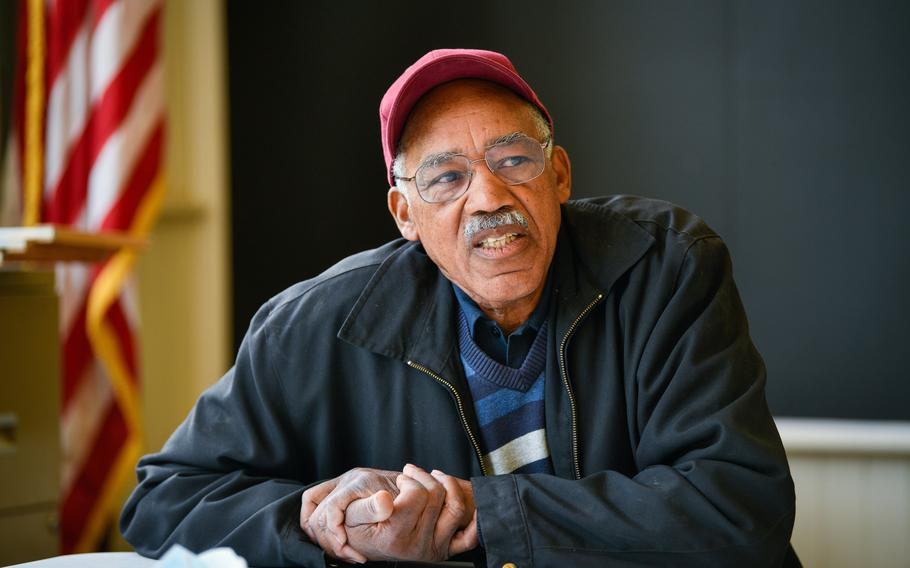
Newell E. Quinton (1944 - )
Newell Emerson Quinton was born in 1944 to Mary Louise Stanley Quinton and George Bernard Quinton in San Domingo, Maryland. San Domingo, located between Mardela Springs and Sharptown, Maryland, is a rural, isolated, small community situated in northeastern Wicomico County. San Domingo was created by free African Americans in the early 19th century and Newell is a 5th generation descendant of the earliest settlers.
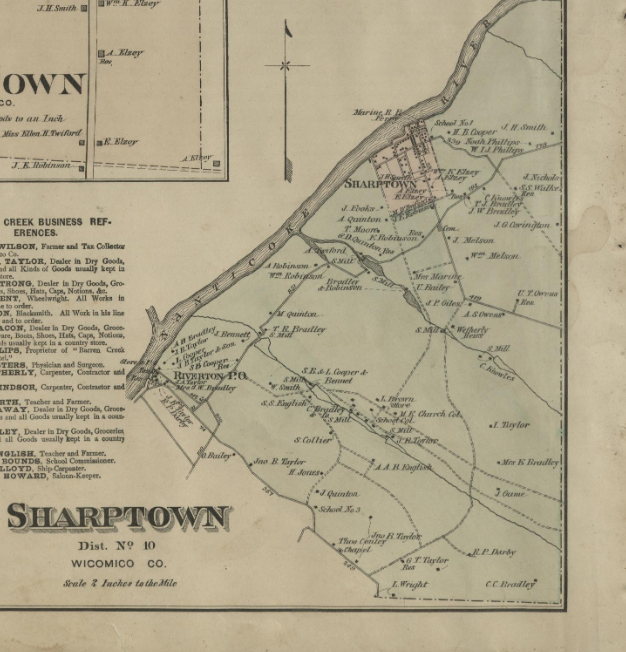
Map of Sharptown from the 1877 Atlas of Somerset, Wicomico and Worcester Counties
San Domingo can be seen south of Sharptown
1877 Atlas of Somerset, Wicomico, and Worcester Counties
Internet Archive
San Domingo can be seen south of Sharptown
1877 Atlas of Somerset, Wicomico, and Worcester Counties
Internet Archive
Newell Quinton, also known as “Sky,” grew up in this rural, segregated, tight-knit community and attended a two-story school known as the Sharptown Colored Elementary School. His boyhood memories were of farm chores, school and softball games and Methodist revivals. Those childhood memories also included neighbors working together to prepare the fields for the cultivation of crops for spring planting. In the fall near Thanksgiving, families gathered together for the task of slaughtering hogs and the preservation of hams, scrapple, sausage and the remainder of the meat for the winter. Those rituals were a way of life for the Quinton family and their neighbors for more than 200 years.
As a child, Newell attended the segregated Sharptown Colored Elementary School that had the traditional pot belly stove which provided uneven heat, the outside pump that provided cool water, and the outside toilets as rest rooms. His books were often outdated, tattered and torn, hand-me-downs from the students in the white schools. His memories also included chores that had to be completed prior to leaving home for school. School was not an option because his parents emphasized the importance of education. Upon graduation from Sharptown, Newell attended high school at Salisbury High School in Salisbury, Maryland, and graduated in 1962. After graduation, Newell attended Morgan State College (MSC), now Morgan State University, in Baltimore, Maryland.
As a child, Newell attended the segregated Sharptown Colored Elementary School that had the traditional pot belly stove which provided uneven heat, the outside pump that provided cool water, and the outside toilets as rest rooms. His books were often outdated, tattered and torn, hand-me-downs from the students in the white schools. His memories also included chores that had to be completed prior to leaving home for school. School was not an option because his parents emphasized the importance of education. Upon graduation from Sharptown, Newell attended high school at Salisbury High School in Salisbury, Maryland, and graduated in 1962. After graduation, Newell attended Morgan State College (MSC), now Morgan State University, in Baltimore, Maryland.
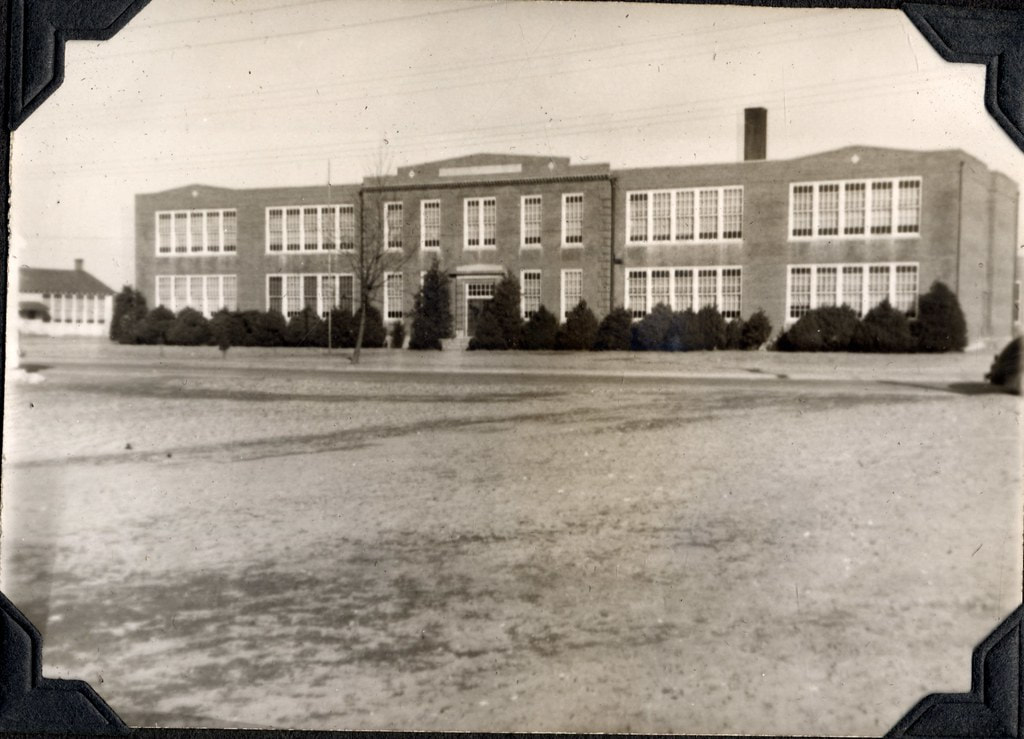
Salisbury High School
Photo from the Baker Family papers (2012.200)
Salisbury University Nabb Research Center
Photo from the Baker Family papers (2012.200)
Salisbury University Nabb Research Center
Even though Newell and the group did not know of Rosenwald’s connect-ion to the school, Newell did know “that his grandpa and his neighbors’ grandpa-rents had built it.” Newell also found that the San Domingo community had also contributed $800 for the building of the school. Newell was also joined in the res-toration project by his wife, Tanja R. Henson-Quinton. Rudolph Stanley also pho-tographed and filmed the progress of the restoration project for posterity. That core group believed that the rural area and farming culture of San Domingo had taught them discipline, and their fight for an education taught them to value it. They also believed that the restoration and preservation of Sharptown Colored Elementary School was their effort to pass those same ideals on to the next generation and to save their history because they also believed that it was their responsibility to continue the legacy of their ancestors. Their focus on the school’s restoration was exceptionally important to them because it was their belief that their education at the school had instilled in them the idea that in order to get something one had to work for it and put time and labor into it to earn it.
With Newell at the helm, the group began to study the history of the com-munity, which proved to be an arduous task because most elders of the commun-ity had died and others had no memory of the past. They turned their complete focus on the Sharptown Colored Elementary School because their families trea-sured the opportunity for their children to obtain an education, even though it was segregated, and, therefore, taught their children that if they got an educa-tion, no one could take it from them. In 2002, the group learned that the Nation-al Trust for Historical Preservation had named Rosenwald Schools to its list of most endangered places. With that knowledge and other information they had gathered, in 2004, Newell Quinton and the group officially began efforts to renovate the school to its original state. After numerous grant applications, the school was restored with about $200,000 in grants from the National Historic Trust, the Maryland Historic Trust, the Community Foundation of the Eastern Shore, and local donations. Preservation Maryland also provided $5,000 for school roof repair. The project reached fruition and on August 23, 2014 the school was dedicated as the San Domingo Community and Cultural Center
In 1966, Newell graduated from Morgan with a Bachelor’s Degree in Mathematics, and he was commissioned as a Second Lieutenant, and began his military service in the United States Army. He was trained as a Signal Officer and worked with computers and communications. He completed a twelve-month tour in Vietnam (September 1967 to September 1968), and received a Bronze Star for meritorious achievement. After Vietnam, Newell served as the Post Signal Officer at Fort Drum, New York, and served as a Research Analyst at Aberdeen Proving Grounds, in Aberdeen, Maryland. After nearly five years on active duty with the United States Army, he continued to serve as a member of the United States Army Reserves in various capacities for a total of 28 years of service.
After five years of active duty with the Army, Newell returned to graduate school at Morgan State College (MSC) and earned a Masters of Business Administration (MBA) in 1978, with a concentration in Management. In 1971, he began his career with the Federal government as a Research Analyst at Aberdeen Proving Grounds. In 1974, he transferred to the National Institutes of Health where he worked as a Management Analyst and later as an Administrative Officer with the Department of Research Services. He later transferred to the Office of Administration, Executive Office of the President, where he was Chief of the Administrative Services Division, until 1982 when he transferred to the Department of Veterans Affairs (VA).
In 1982, Mr. Quinton began his career as Assistant Director of the Veterans Benefits Administration (VBA) Administrative Services Staff. He was named Ad-ministrative Officer in 1985 and in 1987 became special assistant to the Deputy Chief Benefits Director for Automated Data Processing (ADP) Systems Management. He returned to the Administrative Services Staff as Director and served in that capacity from 1988 to 1989. From November of 1989 to September of 1994, he served as Director of the Baltimore Regional Office, where his concern was the overall efficiency of the programs that were formulated at headquarters and how effectively those programs served the needs of the veterans. That task involved the management of a $53 million budget and the delivery of direct services to veterans. In 1992, Newell Quinton was promoted into the Senior Executive Service, and he returned to the Veterans Affairs (VA) headquarters as Director of the Veterans Assistance Service.
In 1995, Newell Quinton was named Chief Information Officer (CIO) of the Veterans Benefits Administration (VBA). There he managed a budget of approximately $120 million with a host of responsibilities, including the maintenance of the VBA information network and the telecommunications program, which provided toll free telephone service as the primary access for the nation’s veteran community. In June of 1999, he returned to the position of Director of the Baltimore Regional Office, and was responsible for the administration and delivery of veteran benefits and service for veterans and their beneficiaries who resided in Baltimore City and 21 of the 23 counties in the State of Maryland. In August of 2002, Mr. Newell Quinton retired from the Department of Veterans and returned to San Domingo and his roots on the Eastern Shore.
Newell Quinton had a stellar career in the military and received numerous awards and honors. He received an award for having served as a member of the Senior Executive Service with the Department of Veterans Affairs from 1992 to 2002; in August of 2002, he received the Distinguished Career Award from the Department of Veterans Affairs; in 1996, he received the Service Award for 30 years of Service to the United States Government from the Department of Veterans Affairs; and in 1968, he was the recipient of the Bronze Star Medal.
Upon his return to San Domingo, Newell built a home on land once owned by his great-grandparents. He was soon involved with a new project and profession- a preservationist. He found that there were very few reminders/memories of the local church, the Sharptown Colored Elementary School, and the tight-knit community that had sustained him in his youth and had encouraged him to succeed. Upon that realization, he enlisted the aid of his cousin, Rudolph Stanley, who taught mathematics in Salisbury, and others. They began to interview elders in the community, collect oral histories, and established a mission to preserve and protect the memories of San Domingo’s past. They also developed a plan to renovate the Sharptown Colored Elementary School where Newell obtained his early education.
From their research, Newell and the core group of volunteers who joined him in the venture to renovate the school, found that the school had been built in 1919. They also discovered to their surprise that the school had been a Rosenwald School, which had been built as a partnership between Julius Rosenwald, a rich Jewish businessman and president of Sears, Roebuck and Company. Rosenwald had partnered with Booker T. Washington, the first principal and leader of Tuskegee Institute, Tuskegee, Alabama, and together they had created a program that helped to build over 5,300 schools, teachers’ quarters and other educational facilities for African Americans across 15 southern states.
Even though Newell and the group did not know of Rosenwald’s connection to the school, Newell did know “that his grandpa and his neighbors’ grandparents had built it.” Newell also found that the San Domingo community had also contributed $800 for the building of the school. Newell was also joined in the restoration project by his wife, Tanja R. Henson-Quinton. Rudolph Stanley also photographed and filmed the progress of the restoration project for posterity. That core group believed that the rural area and farming culture of San Domingo had taught them discipline, and their fight for an education taught them to value it. They also believed that the restoration and preservation of Sharptown Colored Elementary School was their effort to pass those same ideals on to the next generation and to save their history because they also believed that it was their responsibility to continue the legacy of their ancestors. Their focus on the school’s restoration was exceptionally important to them because it was their belief that their education at the school had instilled in them the idea that in order to get something one had to work for it and put time and labor into it to earn it.
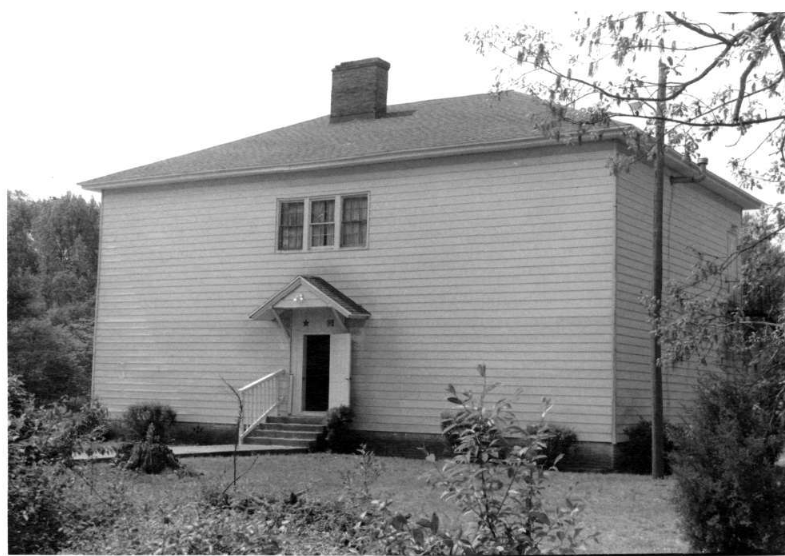
WI-676 San Domingo School Northeast Elevation
Paul Touart Photograph
WI-676 Architectural Survey MD Historical Trust
Paul Touart Photograph
WI-676 Architectural Survey MD Historical Trust
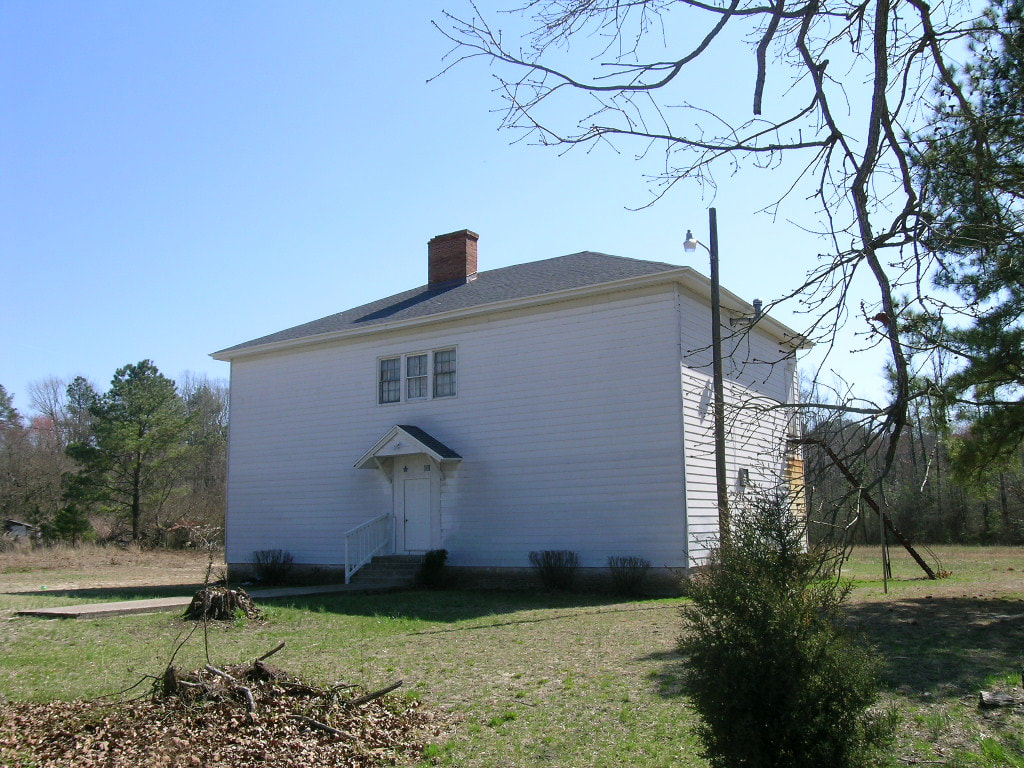
San Domingo School, Front
Preservation Maryland
2005
Preservation Maryland
2005
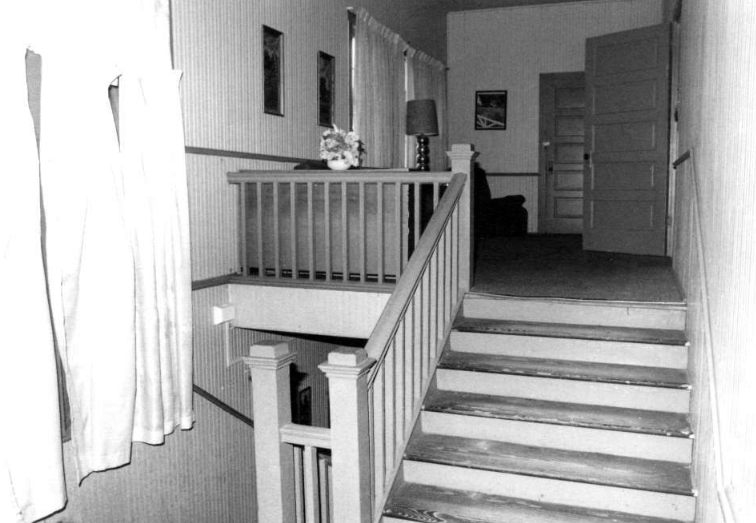
WI-676 Second Floor Hall
Paul Touart Photograph
WI-676 Architectural Survey MD Historical Trust
Paul Touart Photograph
WI-676 Architectural Survey MD Historical Trust
With Newell at the helm, the group began to study the history of the community, which proved to be an arduous task because most elders of the community had died and others had no memory of the past. They turned their complete focus on the Sharptown Colored Elementary School because their families treasured the opportunity for their children to obtain an education, even though it was segregated, and, therefore, taught their children that if they got an education, no one could take it from them. In 2002, the group learned that the National Trust for Historical Preservation had named Rosenwald Schools to its list of most endangered places. With that knowledge and other information they had gathered, in 2004, Newell Quinton and the group officially began efforts to renovate the school to its original state. After numerous grant applications, the school was restored with about $200,000 in grants from the National Historic Trust, the Maryland Historic Trust, the Community Foundation of the Eastern Shore, and local donations. Preservation Maryland also provided $5,000 for school roof repair. The project reached fruition and on August 23, 2014 the school was dedicated as the San Domingo Community and Cultural Center.
Numerous volunteers also gave of their time, energy and effort to help restore the school. In the process, in 1998, the Quinton siblings established the John Quinton Foundation, Inc., a non-profit organization named after their great-grandfather for the purpose of providing educational support to youth through the granting of educational scholarships, awards and tutorials to some college-bound students from San Domingo and the surrounding areas, and the gathering of oral traditions.
Numerous volunteers also gave of their time, energy and effort to help restore the school. In the process, in 1998, the Quinton siblings established the John Quinton Foundation, Inc., a non-profit organization named after their great-grandfather for the purpose of providing educational support to youth through the granting of educational scholarships, awards and tutorials to some college-bound students from San Domingo and the surrounding areas, and the gathering of oral traditions.
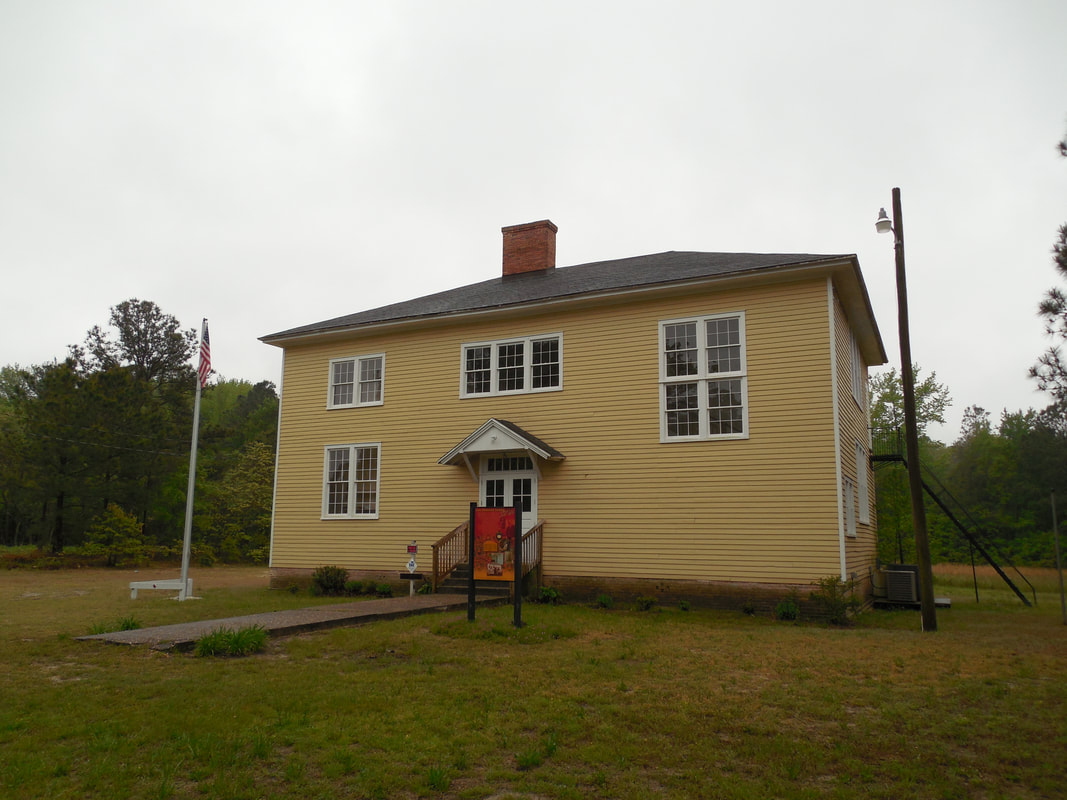
San Domingo School
Photograph by Jimmy Emerson, DVM
May 11, 2016
Photograph by Jimmy Emerson, DVM
May 11, 2016
The school has become a beacon to the community and is a testament to the hard work of Newell Quinton and the other supporters who worked on the project. The second floor of the school serves as a community meeting place and entertainment venue and is also a home to a small Masonic Lodge. The renovation is complete, but Newell Quinton is still very active in preserving other vestiges of the community because he believes that it is his responsibility to continue the legacy of his ancestors. As such, each fall near Thanksgiving, Newell, Rudolph Stanley and others gather for the daylong ritual of slaughtering hogs and the preparation of everything from the salting of hams to the making of scrapple, and sausage for the winter. The processing of the meat is a time-worn memory of years prior to integration, refrigerators and the purchasing of meat from supermarkets, or other food chains. The slaughtering of hogs and other animals as well as the raising of chickens, goats, etc., are also taught by Newell to youngsters and other interested persons in order to pass on to them the values of a community that believed in self-help, independence as well as support and cooperation with one’s neighbors, and “it takes a village to raise a child.” Newell Quinton’s goal is to preserve those memories and the culture of San Domingo, as well as the values he was taught in his youth and helped to sustain him throughout life. In order to spread the word about those values and the slaughtering of animals, he has spoken at the Ward Museum in Salisbury and various other venues.
Mr. Newell Quinton is very well-known for his military career, but locally, he is also known for his outstanding community service and his desire to preserve survival skills and pride in self that were learned from his ancestors. As such, he believed that he must pass those ideals and values onto the next generation or the culture would be lost forever. For his work in the local community, he was the recipient of the Reverend Dr. Martin Luther King, Jr. Achievement Award from the Tri-County Organizations’ Coalition, Inc., in 2012.
Mr. Newell Quinton is still very active in the community. He presently operates Gran’ Sarah’s Hill, a 40-acre farm with 50 goats. The farm is named after his great-grandmother Sarah, the granddaughter of the community founder James Brown. He cares for the farm because it is a labor of love. He also continues to raise and care for hogs so that he can demonstrate the manner in which his ancestors provided for their families during the winter months--survival. As Newell and others continue the ritual of slaughtering animals and teaching others, they offer the food to friends and neighbors who decide to stop by. No portion of the animal is wasted. It is that care of the animals and the land that is so near and dear to him, and that motivates him to continue to follow a way of life that help-ed the San Domingo community to survive for all of those years.
As a testament to his hard work in the preservation of the culture of the community, but specifically for the renovation of the school, in 2023 the San Domingo School was selected and honored as one of two examples of Rosenwald Schools throughout the State of Maryland. Newell Emerson Quinton is truly a preserver of culture.
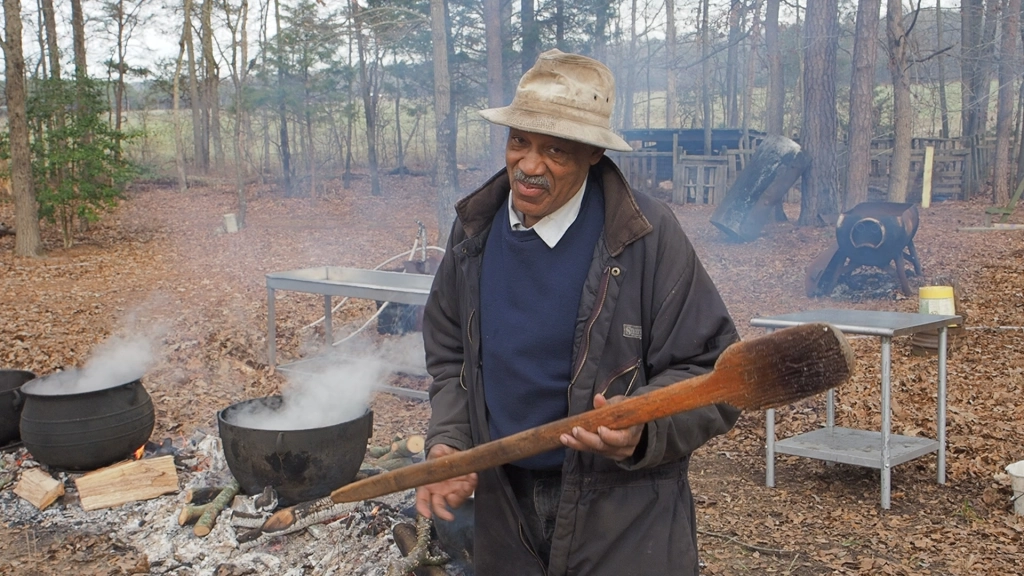
Newell Quinton Making Scrapple
From Savoring Scrapple, Saving San Domingo
Tom Horton
c. 2020
From Savoring Scrapple, Saving San Domingo
Tom Horton
c. 2020
Article by Andre Nieto Jaime
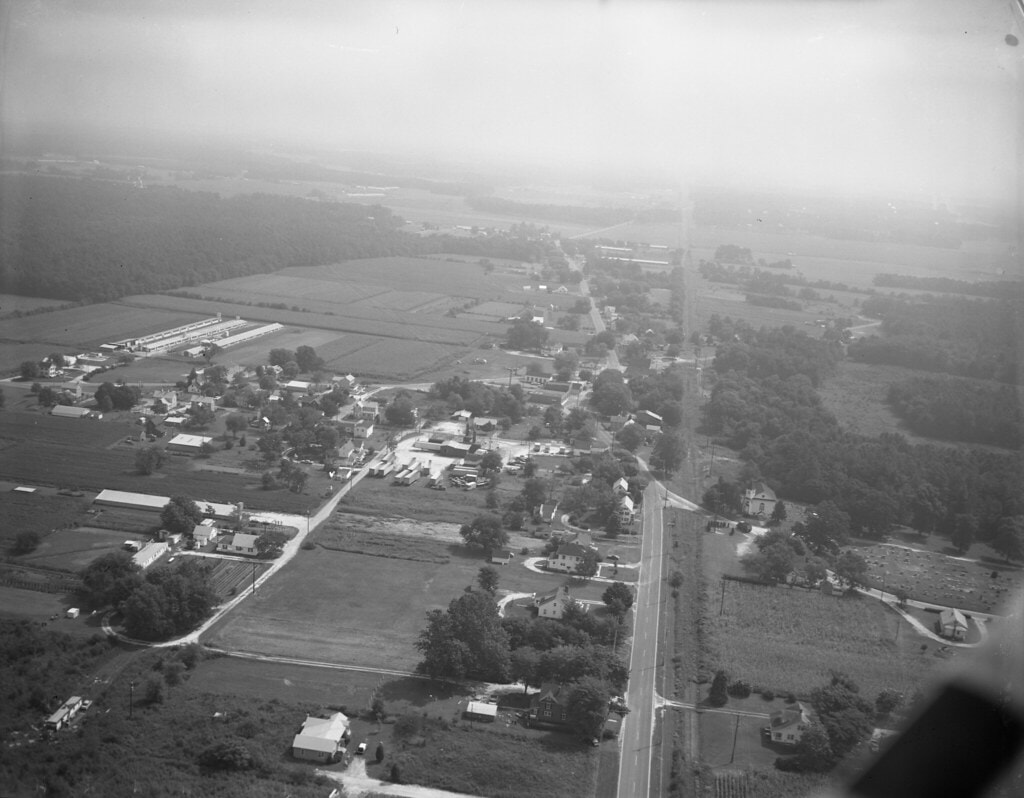
Aerial, Parsonsburg, Maryland
Walter Thurston Photograph Collection (2016.096)
Nabb Research Center
Walter Thurston Photograph Collection (2016.096)
Nabb Research Center
The small towns of Eastern Wicomico County, such as Willards and Pittsville, share much in common. They all emit a quaint, old small-town vibe and are surrounded by acres of fields that reflect the importance of agriculture in Eastern Shore culture. The history of this area also shares much in common. For instance, the introduction of the railroad in the late 19th century gave these towns promoted development by giving a boost to agricultural exports, such as strawberries. The railroad also opened the door for factories and lumber mills to thrive. However, another detail in the history of these towns that is often omitted: Black life. African Americans lived similar work lives as their white neighbors, with many being farmers themselves. Domestic services were also provided by African Americans, with many Black women serving as washer women and servants in white households. African Americans also provided labor for the emerging industries in the area, becoming factory and mill workers. Black workers contributed to the emergence of small towns in Wicomico County by working in several key areas, especially agriculture, and these contributions deserve to be highlighted in the history of the area.
After the abolition of slavery, newly freed men and women were not given much to start off from. Most would have lacked an education due to restrictions placed on educating the enslaved. They also lacked generational wealth, thus having no safety net or pre-existing funds to ease their economic struggles. Racial barriers imposed by emerging Jim Crow restrictions also made employment difficult for Black Americans. The only experiences that most formerly enslaved had were farming and domestic work. Thus, following the Civil War, African American occupations tended to fall into these two fields until greater amounts of Black Americans received higher education and training in skilled labor. This is reflected by the lives of African Americans in rural Wicomico County, with most being farmers or some type of domestic worker.
Farming has been a way of life on the Delmarva Peninsula for centuries, even prior to European settlement. In the late 19th and early 20th centuries agriculture remained important, with many Eastern Shore inhabitants continuing to live and work on farms. Even after the Civil War, African Americans provided much of the labor for these farms as either farm hands or working their own farms. According to a publication by the U.S. Department of Commerce from 1935, there were 21,782 Black workers in Maryland listed under the category of agriculture for their occupation. 20,956 of these workers were classified as males, making it the dominant occupation for Black male workers. Examining census data from Wicomico County reflects a similar story, with farmer or farm laborer appearing as the dominant occupation for Black males.
Nathaniel Trader from Glass Hill was just one of the many Black farmers on the Shore. He first appears in the 1870 Census in the Pittsburg Election District at 17 years old living with his parents Solomon and Elizabeth Trader, both also from Glass Hill. Here, Nathaniel is listed as working on a farm, presumably his father’s farm since Solomon is listed as a farmer. It is not made apparent whether this farm is owned or rented, the label farmer (as opposed to works on farm, farm hand, or farm laborer) suggests that Solomon does not farm for a wage and instead farms to produce crops for sale, to pay rent (i.e. share cropping or tenant farming), or for subsistence.
Moving forward ten years to the 1880 Census in the Parsons Election District, Nathaniel was noted as being 26. He was now also living with his wife Harriet as well as his children Elijah and Ida. Additionally, Nathaniel was now a farmer himself, but as with the 1870 Census, there is no indication about whether his farm was owned or rented. However, the 1900 Census reveals that the farm was rented. Here Nathaniel was still listed as a farmer, but he now had the help of his sons Elijah and Washington. However, things change in the 1920 Census. Nathaniel, now 69 years old, was enumerated as a farm laborer who was “working out”. Perhaps Nathaniel's age and the fact that he now only lives with his wife made it difficult for him to run a farm on his own so farming as wage laborer was more practical. Whatever the case may be, Nathaniel spent most of his life farming in rural Wicomico County until his death in 1930. Farming became the way he sustained himself and his family. Nathaniel Trader and other Black farmers were part of the farming community that helped define the Eastern Shore’s culture.
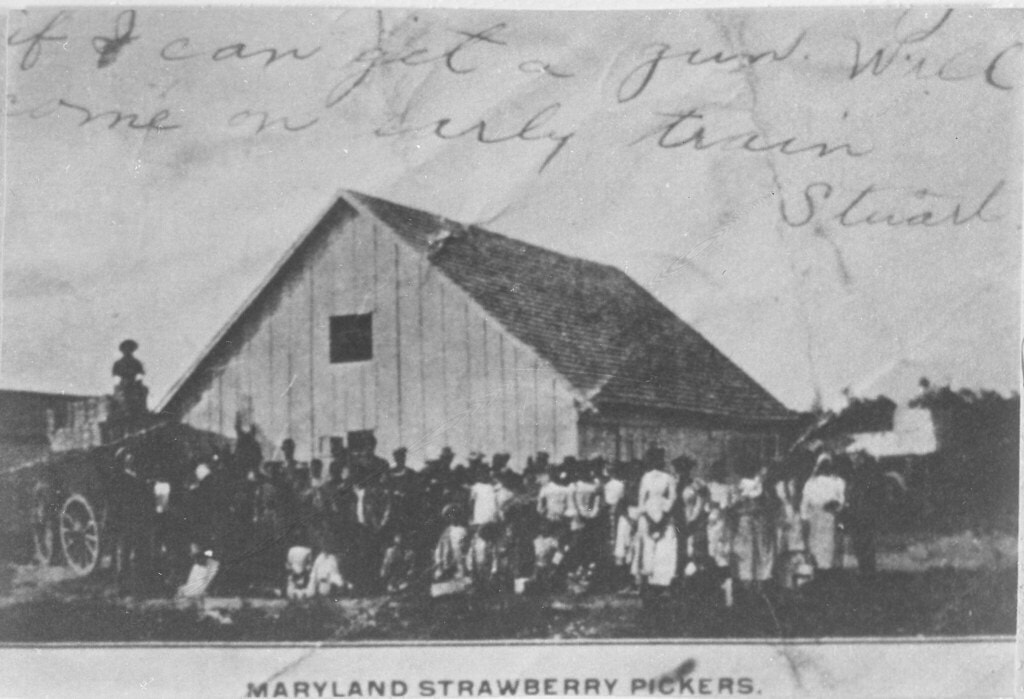
Maryland Strawberry Pickers
Walter Thurston Photograph Collection (2016.096)
Nabb Research Center
Walter Thurston Photograph Collection (2016.096)
Nabb Research Center
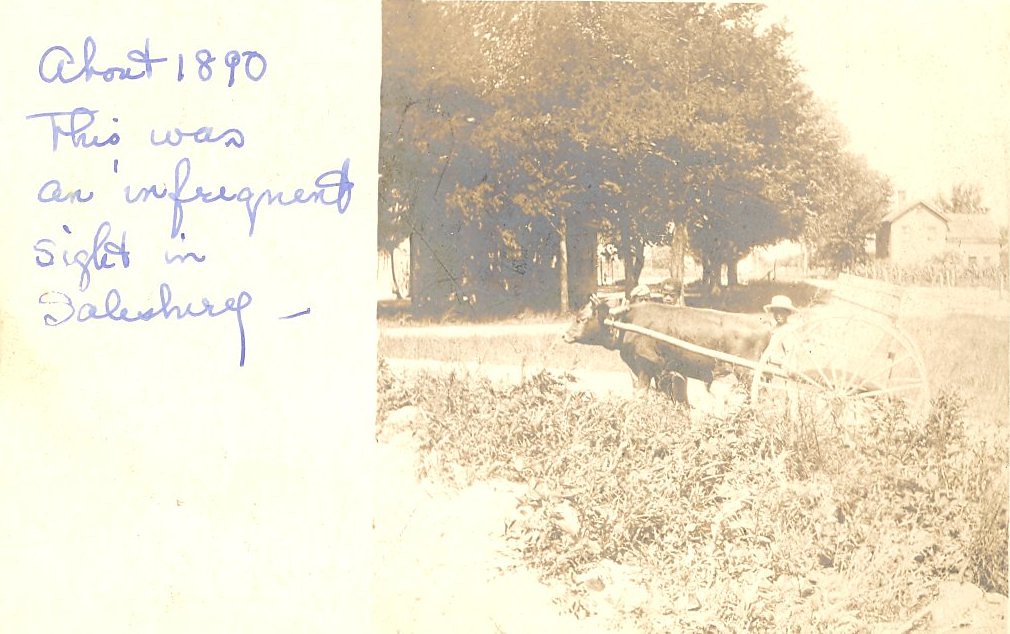
This was an Infrequent Sight in Salisbury
c. 1890
John Jacob Collection Postcards
Nabb Research Center
c. 1890
John Jacob Collection Postcards
Nabb Research Center
Domestic service was another field of work that was common among Black workers in Wicomico. When observing statistics, Black women far outnumbered the number of Black men. In 1930, 27,142 Black women in Maryland were recorded as servants and an additional 1,243 women were listed as laundry operatives. In comparison, there were 3,934 men working as servants and only 230 men who were laundry operatives. As was the case with Black farmers, census records show that a significant number of Black women and even young children were employed as domestic servants in the late 19th and early 20th centuries.
Mary Holloway was one such domestic worker who in 1880 at the age of fifteen was working as a servant living with the family of William and Elizabeth Adkins. There was also a young Black girl who at the age of ten, Kate Hamblin, who was living with and working as a servant for the White family of John and Hester Hamblin. It is worth noting that they share the same surname, however, whether this was just a coincidence or there is some connection is uncertain. Being ten years old, Kate is too young to have been formerly enslaved and John’s occupation in the 1860 Census of Derrickson’s Crossroads (Pittsville’s former name) was listed as a merchant, so it is unlikely he would have owned slaves anyway. Nonetheless, the formerly enslaved inheriting the surnames of their former enslavers was a common practice, as was becoming employed by them.
In addition to working as servants, it was common for Black women in eastern Wicomico County to be employed as washerwomen. The 1880 Census of the Dennis District, which is the area around Powellville, contains the name of one such woman, Sally Harvy. Sally Harvy was 31 at the time and living with her husband, Harvy Henry, and their children. Meanwhile, Harvy was employed as a day laborer while their eldest son, Charly, was employed as a farm hand at the young age of twelve. Even years later this form of domestic work was common among Black women. In the 1930 Census of the Pittsburg District Marie West, age 75, and her granddaughter Roxie West, age 26, were both listed as laundresses. Further down the list there was also Emma Parker with her daughter Rosa Parker, ages 57 and 30 respectively. Countless African American women worked domestically following the end of the Civil War to help augment their family’s income and build up the generational wealth that they were denied.
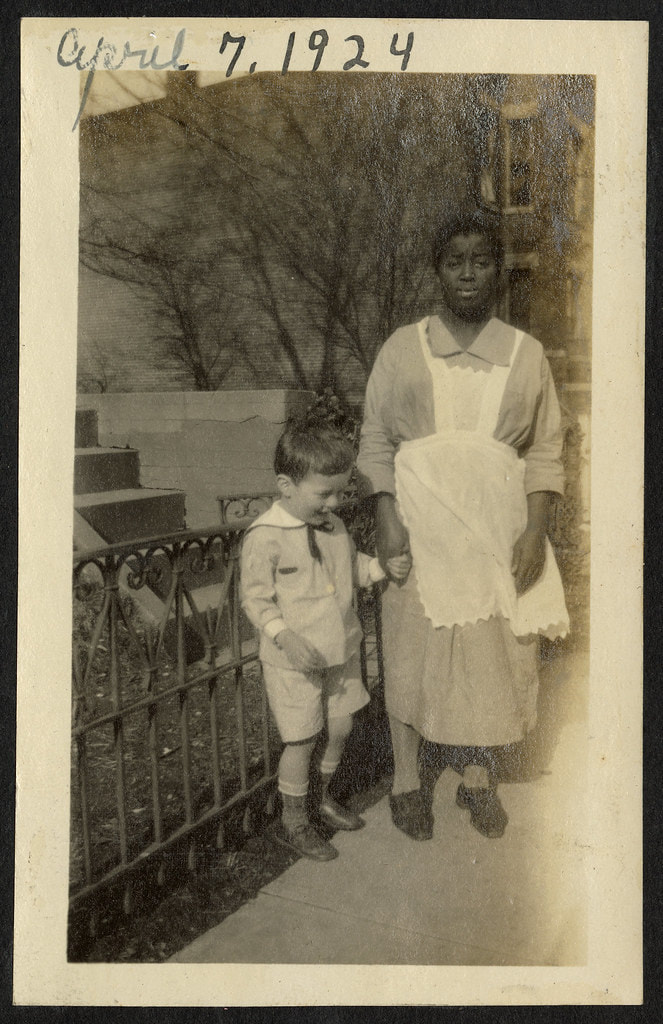
An African American Woman Stands with a Boy
1924
Purnell & Winder Families Photograph Collection (2018.011)
Nabb Research Center
1924
Purnell & Winder Families Photograph Collection (2018.011)
Nabb Research Center
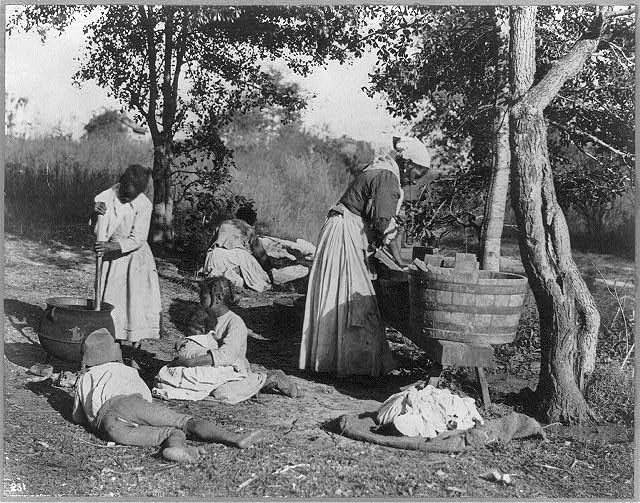
African-American Woman Doing Laundry
c. 1900
Library of Congress
c. 1900
Library of Congress
While agricultural and domestic employment was common for Black Marylanders following the Civil War, they also contributed to the local economy in other occupations, especially in the 20th century. The small towns dotted across the eastern half of Wicomico County all experienced booms due to the installation of the Wicomico Pocomoke Railroad line running from Salisbury to Ocean City. Several towns, such as Pittsville, became stops along the railroad and saw several new shops, factories, and even a hotel sprout up as a result. For example, in the early 20th century several auto dealers were built within Pittsville and with those cars comes the need for automotive maintenance. One African American resident of Pittsville found employment within this quickly growing industry as a machinist at an auto repair shop according to the 1930 Census.
In addition to the auto industry, several families emerged as proprietors of canning factories. One factory was opened by Paul G. Wimbrow who owned several canneries including one in Snow Hill and another in Pittsville. Lambert J. Powell was another owner of a canning factory living in the Pittsville area and other families such as the Jones families were known to be factory owners. Census data reveals that African Americans worked in some of these canneries. Powell, for instance, had a Black man named Harry Cutler boarding with him who was recorded as a laborer at a canning factory, almost certainly Powell’s factory.
In addition to the auto industry, several families emerged as proprietors of canning factories. One factory was opened by Paul G. Wimbrow who owned several canneries including one in Snow Hill and another in Pittsville. Lambert J. Powell was another owner of a canning factory living in the Pittsville area and other families such as the Jones families were known to be factory owners. Census data reveals that African Americans worked in some of these canneries. Powell, for instance, had a Black man named Harry Cutler boarding with him who was recorded as a laborer at a canning factory, almost certainly Powell’s factory.
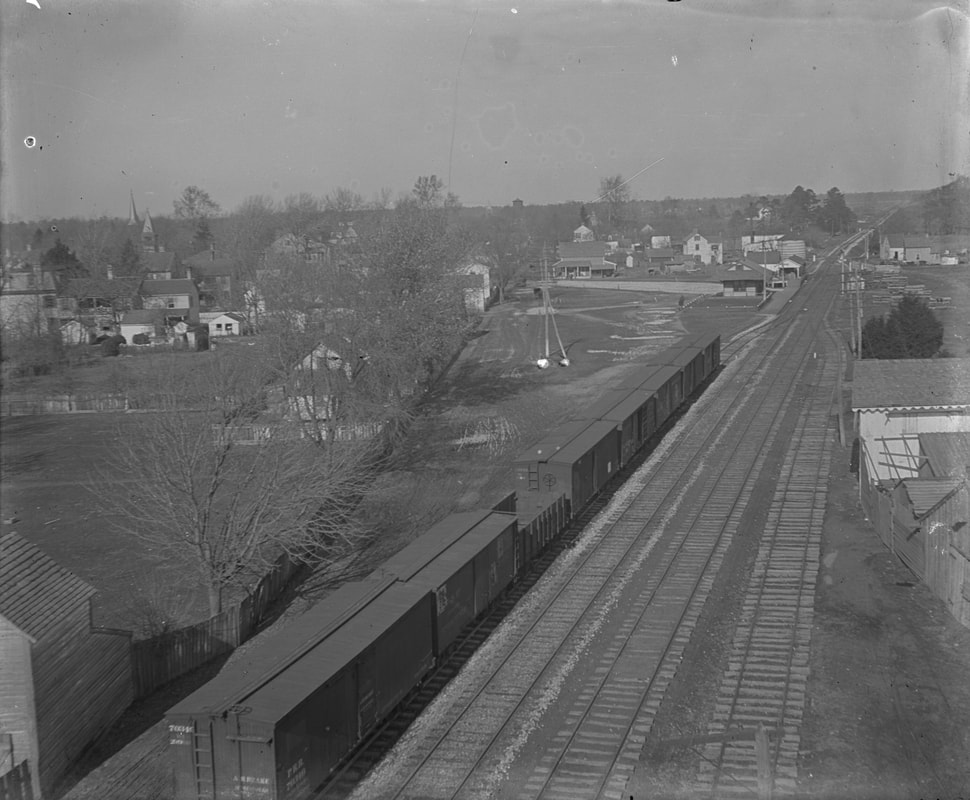
Railroad Station & Cannery
E.I. Brown Glass Plate Negatives collection (2001.006)
Nabb Research Center
E.I. Brown Glass Plate Negatives collection (2001.006)
Nabb Research Center
The lumber industry in the area also benefited greatly from the railroad, allowing easier transportation of timber and lumber to and from sawmills. Parsonsburg’s sawmills, one of which was located directly north of the line, both saw a boom in business. In 1872, Salisbury Advertiser published an article about Parsons Switch petitioning for a post office and to have its name changed to Parsonsburg. In this same article, it is written that two million feet of lumber was purchased the year before from Parsonsburg alone by a firm located in Salisbury, demonstrating the success of Parsonsburg’s two lumber mills of the time. Pittsville, Willards, and even the crossroads town of Powellville further south all witnessed a growth in their lumber industries which translated to opportunities for Black workers. Both Samuel and George Harmon, brothers living in the Pittsville area, were able to secure work in a sawmill. However, having trees to turn into lumber requires people to fell those trees and many African Americans took up this line of work. Many of these timber cutters lived in the Dennis Election District, such as 20-year-old Lenord Coles and 58-year-old John D. Adams, just to name a few. These individuals helped fulfill the demand for lumber in the early 20th century.
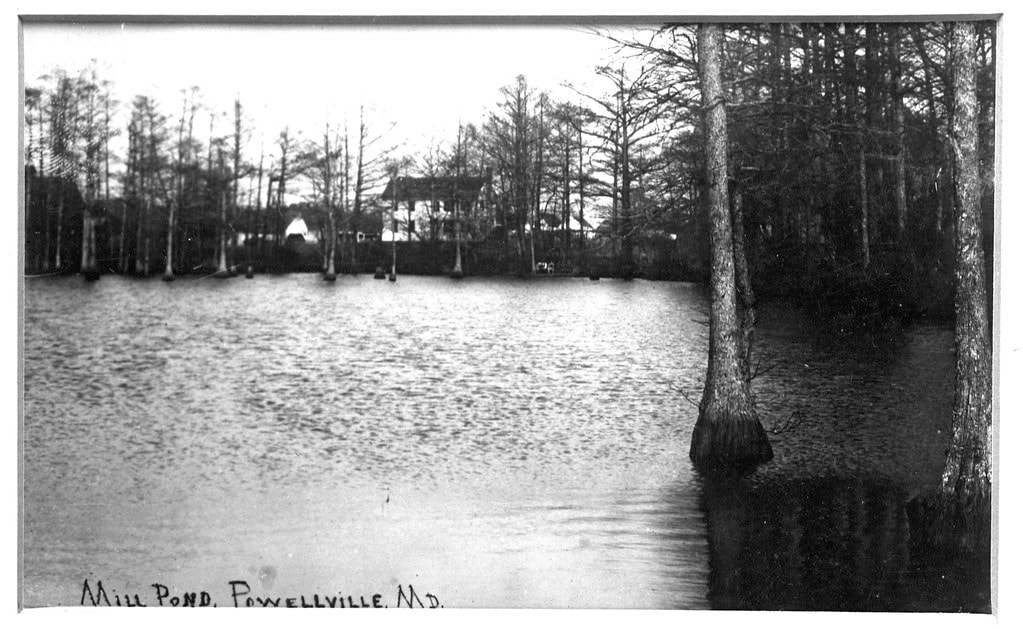
Powellville, MD., Mill Pond
Walter Thurston Photograph Collection (2016.096)
Nabb Research Center
Walter Thurston Photograph Collection (2016.096)
Nabb Research Center
A trend can be discerned by observing the occupations of Black Wicomico residents and comparing them as time goes on. Initially, in the late 19th century one notices that children often took up the work of their parents, especially in this case where there is not much option for economic or social mobility. This can be seen with Emma Parker and her daughter Rosa working as laundresses or the countless sons like Nathaniel Trader helping their fathers on their farms and becoming farmers themselves. This mirrors the condition of Black workers across the nation following the end of the Civil War who were not given much, if anything, to start their new lives with. Increased educational opportunities afforded to their children, through the efforts of the Freedmen’s Bureau and later Rosenwald Schools, helped improve economic mobility for African Americans.
Black residents in Wicomico County not only helped the development of these towns, which peaked in the late 19th early 20th century, but they also helped define the culture of the Shore. Numerous Black men worked in similar industries as their white neighbors, especially agriculture, that are important staples of life here on the Lower Eastern Shore. They also found employment in emerging industries that came from the development of the railroad through the Eastern Shore, working in newly built factories, mills that witnessed a boom in business, cutting the timber that those mills required, and working on the railroad itself as was the case with William Nichols in the Parsons District. Meanwhile, Black women provided domestic services for many White families by working as not only servants, washer women, and laundresses, but also as home makers for their families. Countless women were listed as either having no occupation or listed as being at home for their occupations. This does not mean that they were idle at home, instead, they were almost certainly performing the vital and underappreciated task of maintaining the home. Black men and women contributed to the economy and society in rural Wicomico County in ways that are often overlooked while examining the history of the area and it is important to recognize their contributions to our collective history.
Black residents in Wicomico County not only helped the development of these towns, which peaked in the late 19th early 20th century, but they also helped define the culture of the Shore. Numerous Black men worked in similar industries as their white neighbors, especially agriculture, that are important staples of life here on the Lower Eastern Shore. They also found employment in emerging industries that came from the development of the railroad through the Eastern Shore, working in newly built factories, mills that witnessed a boom in business, cutting the timber that those mills required, and working on the railroad itself as was the case with William Nichols in the Parsons District. Meanwhile, Black women provided domestic services for many White families by working as not only servants, washer women, and laundresses, but also as home makers for their families. Countless women were listed as either having no occupation or listed as being at home for their occupations. This does not mean that they were idle at home, instead, they were almost certainly performing the vital and underappreciated task of maintaining the home. Black men and women contributed to the economy and society in rural Wicomico County in ways that are often overlooked while examining the history of the area and it is important to recognize their contributions to our collective history.
References
Primary Sources:
Entry for John S. Hamblin. United States Census, 1860, Household Identifier 2186, Line Number 33 309 Page Number 9. FamilySearch. Salt Lake City, Utah
Entry for Nathaniel Trader. United States Census, 1880, Household Identifier 69, Line Number 21 Page Number 14. FamilySearch (https://www.familysearch.org/ark:/61903/1:1:MN79-KLG : Fri Mar 08 19:30:58 UTC 2024). Salt Lake City, Utah.
Entry for Nathaniel Trader. United States Census, 1870, Household Identifier 94, Line Number 12 Page Number 9. FamilySearch (https://www.familysearch.org/ark:/61903/1:1:MN35-PW3 : Tue Mar 05 10:11:39 UTC 2024). Salt Lake City, Utah.
Entry for Nathaniel Trader. United States Census, 1900, Household Identifier 12, Line Number 60 Page Number 1B. FamilySearch (https://www.familysearch.org/ark:/61903/1:1:M32V-9C8 : Tue Mar 05 14:29:07 UTC 2024). Salt Lake City, Utah.
Entry for Samuel Harmon and George. United States Census, 1920, Household Identifier 25, Line Number 51 Sheet Number 2B. FamilySearch (https://www.familysearch.org/ark:/61903/1:1:M677-C3D : Sun Mar 10 16:35:58 UTC 2024). Salt Lake City, Utah.
15th Census, population, 1930. [microform]. Reel 881. Internet Archive. San Franciso, California.
“Paul G. Wimbrow.” The Daily Times, May 13, 1988.
10th Census, 1880, Maryland [microform]. Reel 0517. Internet Archive. San Franciso, California.
13th Census, 1910 [microform] Population Maryland. Reel 570. Internet Archive. San Franciso, California.
U.S. Department of Commerce and Bureau of the Census. Negroes in the United States: 1920-1932. Washington D.C.: United States Government Printing Office, 1935.
Secondary Sources:
Custis, Colbi. Town of Pittsville. “History.” Last modified July 2019. https://pittsvillemd.gov/history/
Hutson, Cathy Wilkins. “Nathaniel Trader.” Find a Grave. Last modified March 24, 2022. https://www.findagrave.com/memorial/237907825/nathaniel-trader
Mandle, Jay R. Continuity and Change: The Use of Black Labor After the Civil War.” Journal of Black Studies 21, no. 4 (June 1991): 414-427.
Smith, John David. “The First Friend: The Freedmen’s Bureau.” In We Ask Only for Even-Handed Justice: Black Voices from Reconstruction, 1865-1877, 38-47. Amherst: University of Massachusetts Press, 2014.
Vedder, Richard K. “Four Centuries of Black Economic Progress in America.” The Independent Review 26, no. 2 (Fall 2021): 287-306.
WI-504 Willard Survey District Architectural Survey File, 29 August 2003. Maryland Historical Trust Maryland Inventory of Historic Property Form Inventory No. WI-504, Maryland Historical Trust, Crownsville, MD. https://apps.mht.maryland.gov/medusa/PDF/Wicomico/WI-504.pdf
WI-571 Powellville Survey District Architectural Survey File, 29 August 2003. Maryland Historical Trust Maryland Inventory of Historic Property Form Inventory No. WI-571, Maryland Historical Trust, Crownsville, MD. https://apps.mht.maryland.gov/medusa/PDF/Wicomico/WI-571.pdf
WI-489 Pittsville Historic District Architectural Survey File, 04 April 2013. Maryland Historical Trust Maryland Inventory of Historic Property Form Inventory No. WI-489, Maryland Historical Trust, Crownsville, MD. https://apps.mht.maryland.gov/medusa/PDF/Wicomico/WI-489.pdf
WI-487 Parsonsburg Survey District Architectural Survey File, 29 August 2003. Maryland Historical Trust Maryland Inventory of Historic Property Form Inventory No. WI-487, Maryland Historical Trust, Crownsville, MD. https://apps.mht.maryland.gov/medusa/PDF/Wicomico/WI-487.pdf
Article by Dr. Clara Small
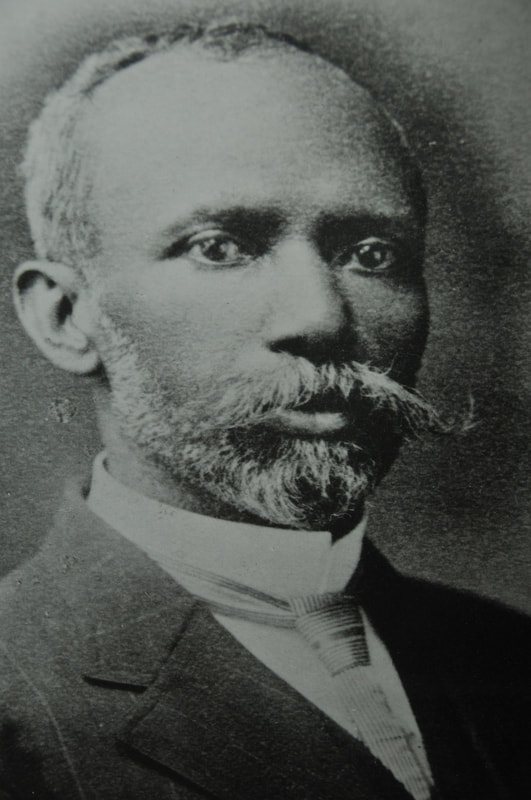
William C. Jason Sr.
(1859-1943)
(1859-1943)
William Charles Jason was born October 21, 1859 in Trappe, Maryland to William Jason, an ordained minister and Mary Wing Jason, the daughter of Charles Wing, a Methodist clergyman, of Wilmington, Delaware. William Jason’s life was governed by his Christian heritage, a quest for knowledge, and a desire to educate others.
William’s early years were spent in Easton and Cambridge, Maryland. After losing his mother at an early age, Jason and his three brothers were reared by their father. By the age of fifteen, Jason was apprenticed to a printer in Easton. He also learned to be a barber and opened his own shop in Easton at age eighteen. However, he desired to obtain an education, so he sold his barbershop and went to Lima, New York to attend Genesse Wesleyan Seminary, a Methodist Episcopal Preparatory School. His tuition was paid by him operating a barbershop in that area. Through hard work and persistence, he graduated cum laude from the seminary in 1884.
His quest for knowledge was incomplete, so in the fall of 1884 he enrolled in Allegheny College at Meadville, Pennsylvania. From that institution, he earned a Bachelor of Arts degree in 1888 and a Master of Arts in 1889. In 1891, he earned a Bachelor of Divinity degree from Drew Theological Seminary in Madison, New Jersey. After obtaining his degree from Drew Seminary, William Jason was accepted into the Delaware Conference of the Methodist Episcopal Church. A few years later, Wiley University in Marshall, Texas bestowed upon him the degree of Doctor of Divinity.
As a minister of the gospel, William Jason’s first charge was in Orange, New Jersey, and within four years, he had erected a church. An earlier apprenticeship as a printer in Easton, Maryland was instrumental in providing him the funds for the erection of the church. He also served as the pastor at the Tindley Temple at the Bainbridge Street Memorial Church and the Janes Church in Philadelphia. In 1896, he was released from his pastorate to become the President of Delaware State College (DSC) at Dover, now Delaware State University.
The college was established on May 15, 1891, as the State College for Colored Students by the Delaware General Assembly under the provisions of the Morrill Act of 1890. That act provided for land grant colleges for Blacks in states that maintained separate educational facilities. Delaware State College opened its doors to students in 1892, and Dr. William C. Jason was elected as the second president, the first black president of the college, and the dominant personality during the first 25 years of its existence. When he took over the reins of the college, the school consisted only of the old mansion house of the Lockerman plantation and a stable which had formerly been the slave quarters.
Dr. Jason assumed the task of developing “the college as an instrument for the upgrading of the Negro in Delaware.” One of his goals was to raise funds among Delaware Negroes to transform the old slave quarters into a chapel, because he wanted “to make over a place of misery and horror into a place of rejoicing.” His overall goals were to educate the youth of Delaware and for making Negro youth in Delaware aware of the opportunity for higher education; for hiring Alice Ruth Dunbar-Nelson, the wife of Paul Laurence Dunbar, the preeminent Black poet and author, to conduct the summer school for Negro teachers; for lobbying the state legislature for funding to operate Delaware State College and the summer school; and finally, for improving the quality of the faculty at the college. Dr. Jason hired the most highly trained and educated individuals to teach and educate future teachers despite the fact that he was not allocated adequate funds to accomplish the job. One of his highly respected teachers at the school, Pauline A. Young, stated that Dr. Jason was “expected to build academic and industrial agricultural curricula simultaneously without adequate funds, staff, or physical plant.”
Dr. Jason served as president of the college for 28 years, from 1895 until 1923. During that period, he provided black schools in Kent and Sussex Counties with their first highly qualified teachers. In 1923, he resigned his presidency and returned to his first love, active ministry in the Delaware Conference. He offered his resignation only after he had seen the college grow to the point that he believed it could sustain itself under new leadership. Upon his return to the ministry, Dr. Jason served charges in Cheswold, Dover, Smyrna, and Milford, and in Maryland-St. Michaels, Oxford, Delmar, and the Centreville Circuit. In 1936, he returned to Delaware State College and served as Chaplain until his health began to fail and he resigned in1941, not just from being chaplain, but also from active duty in the Delaware Conference.
Dr. Jason spent the latter days of his life not far from Delaware State College in a house he had built among the trees he had planted just across the bridge from the college. A week before he died, he calmly said that he “knew that his work was done.” He died July 8, 1943.
Dr. William C. Jason was a beacon of light for the education of students, especially for black students throughout the state of Delaware, specifically to the lower counties of the state. In 1950, the William C. Jason Comprehensive High School was opened in Georgetown, Delaware to fill the educational vacuum for blacks in lower Delaware. It was funded through a bequest of the philanthropist, H. Fletcher Brown, who stipulated in his will that $250,000 of his estate be given to help build a Negro high school somewhere in the lower part of the state. The William C. Jason Comprehensive High School became the first African American secondary school in Sussex County. The school was a legacy to Dr. Jason’s commitment to prepare Negro youth for the future and to stress the value of strong character and morality. In June of 1967, when Delaware’s public schools were desegregated, Jason Comprehensive High School closed its doors and it later became a part of Delaware Technical and Community College. A second reminder of his legacy is that the library at Delaware State University is known as the William C. Jason Library, which also stands as a testament to his life’s work.
Recently, Dr. William C. Jason was also remembered by another factor as well, Jason Beach. Jason Beach, located in Trap Pond State Park, outside of Laurel, Delaware, had been a recreational destination for the Black community in the mid-1900s and the beach was named after Dr. Jason, the longest serving president at Delaware State College, now, University. After the passage of the 1964 Civil Rights Act, Jason Beach was no longer for segregated recreation and entertainment and it became known as Cypress Point. However, on June 21, 2022, Governor John Carey, Natural Resources Secretary Shawn Garvin, some elected officials, and some area students gathered at the site on the Juneteenth holiday and unveiled a Delaware Public Archives historical marker and declared Jason Beach a historic site and returned it to its rightful name, of Jason Beach. In remembrance of its original name, some students and others were encouraged to research and learn the many accomplishments of Dr. William C. Jason.
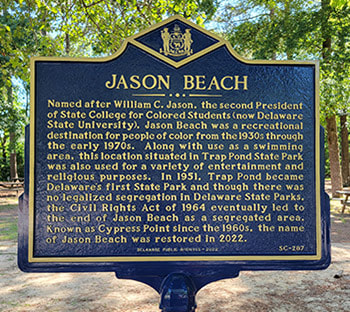
Jason Beach Marker
Delaware State Parks
Delaware State Parks
Archives
September 2026
August 2026
July 2026
June 2026
May 2026
April 2026
March 2026
February 2026
December 2025
November 2025
October 2025
September 2025
August 2025
July 2025
June 2025
May 2025
April 2025
March 2025
February 2025
January 2025
December 2024
November 2024
October 2024
September 2024
August 2024
July 2024
June 2024
May 2024
April 2024
March 2024
February 2024
January 2024
November 2023
September 2023
August 2023
June 2023
May 2023
July 2022
June 2022
May 2022
December 2021
November 2021
August 2021
February 2021
January 2021
November 2020
October 2020
September 2020
August 2020
 RSS Feed